Showing posts with label World News. Show all posts

Thursday, October 17, 2013

Dr. Martin MacNeill's Forgeries and Malpractice Exposed


I have been watching as Dr. Martin MacNeill is going on trial for the murder of his wife, and I am thinking it is about time. But, I keep hearing that he is a doctor and lawyer that forged transcripts to get into colleges in both medicine and law. So knowing he is a double major which many are I wondered how he pulled it off, and now that I know he was arrested for forgery I wanted some insight into his back ground to say the least. I have found that he is board certified believe it or not in Family, Emergency, Orthopedic Surgery, and he practiced Criminal Law. Where most double majors I know become a doctor and a lawyer to specialize in malpractice cases, and most do not become specialized in any certain field of medicine. I did see were he can no longer practice medicine and that it will be 10 years before he can apply for licensure. He was licence in Washington and Utah.

I am amazed that this guy could have pulled this off for so long. Just think you have to have 3 forms of identification to take the boards and transcripts to submit plus rigorous interviews. I don't know about the bar but evidently he had to pass the bar as well to practice law. How can you forge all that? Now I am wondering if he ever cared for patients and if so in what fields?

If he goes free for murder I am sure that what ever patients or clients he had while practicing medicine and law will sue him out the Ying-Yang. Really the doctor of family,emergency medicine and law is bad enough, but I wonder how many ortho patients was subjected to his use of the gigli saw? Yikes This guy reminds me of the movie "Catch Me If You Can" although the true life character in the movie never killed his wife or was licensed to practice medicine in two states.


This is truly scary that this could happen not just killing his wife, but all his forgeries and malpractice that he got away with for years.


Sunday, October 13, 2013

Miley Cyrus' Ridiculous Outfit Leaves Literally Nothing to the Imagination


Oh god. It's getting worse. Much worse. I thought Miley Cyrus would, for lack of a better phrase, tone it down a bit after she and Liam Hemsworth broke things off, but no. Not even a little. Whatever the opposite of toning down is? That's what Miley's doing. Need proof? Just shift your gaze to this photo of Miley wearing little more than tape over her boobs and a pair of undies.

Typically, when a girl and a guy break up, one of the first telltale signs of how things are going for the female is how she starts dressing. If Miley were suddenly spotted in jeans, t-shirts, and sneakers, we'd probably think: "Hey, Miley seems to be more introspective lately. Maybe she's thinking about how she's been acting and starting to regret some of her recent antics?" Or if she started walking around looking completely unkempt -- hair a mess, pajama pants on -- we may think: "Yikes. Miley really doesn't seem to be doing well right now. I hope she's okay." But the fact that Miley is dressing more revealing than she has in the past (who thought that was possible?), it makes us think: "Wow, Miley doesn't seem to be doing all that well ... and she has absolutely no idea whatsoever. Also, she isn't going to stop any time soon!"

This ... is not an outfit. It's a fishing net and some office supplies. I'm not sure who told Miley after she got dressed: "Yeah! That's a great idea to wear that in public!" But whoever it is, they're not her real friend; they're her mortal enemy. Because this is ridiculous. Miley has a hot body, and if she wants to show it off, she has every right to. But I really have no clue what the hell is going on here. It actually could be her worst fashion choice yet. And after the non-clothes she wore to the VMAs, that's saying a lot.

Miley, I hope you're okay, girl. Kind of doesn't look like it.


WHAT DO YOU THINK OF MILEY'S OUTFIT?


Wednesday, October 9, 2013

The Doctor Won't See You Now. He's Clocked Out...

ObamaCare is pushing physicians into becoming hospital employees. The results aren't encouraging.

Big government likes big providers. That's why ObamaCare is gradually making the local doctor-owned medical practice a relic. In the not too distant future, most physicians will be hourly wage earners, likely employed by a hospital chain.

Why? Because when doctors practice in small offices, it is hard for Washington to regulate what they do. There are too many of them, and the government is too remote. It is far easier for federal agencies to regulate physicians if they work for big hospitals. So ObamaCare shifts money to favor the delivery of outpatient care through hospital-owned networks.

The irony is that in the name of lowering costs, ObamaCare will almost certainly make the practice of medicine more expensive. It turns out that when doctors become salaried hospital employees, their overall productivity falls.

health system. A recent survey by the Medical Group Management Association shows a nearly 75% increase in the number of active doctors employed by hospitals or hospital systems since 2000, reflecting a trend that sharply accelerated around the time that ObamaCare was enacted. The biggest shifts are in specialties such as cardiology and oncology

Estimates by hospitals that acquire medical practices and institutions that track these trends such as the Medical Group Management Association show that physician productivity falls under these arrangements, sometimes by more than 25% (more on this below). The lost productivity isn't just a measure of the fewer back surgeries or cardiac catheterizations performed once physicians are no longer paid per procedure, as ObamaCare envisions. Rather, the lost productivity is a consequence of the more fragmented, less accountable care that results from these schemes.

Once they work for hospitals, physicians change their behavior in two principal ways. Often they see fewer patients and perform fewer timely procedures. Continuity of care also declines, since a physician's responsibilities end when his shift is over. This means reduced incentives for doctors to cover weekend calls, see patients in the ER, squeeze in an office visit, or take phone calls rather than turfing them to nurses. It also means physicians no longer take the time to give detailed sign-offs as they pass care of patients to other doctors who cover for them on nights, weekends and days off.

Most hospitals exacerbate these strains by measuring the productivity of the physician practices they purchase in "Relative Value Units." This is a formula that Medicare already uses to set doctor-payment rates. RVUs are supposed to measure how much time and physical effort a doctor requires to perform different clinical endeavors.

Medicare assigns each clinical procedure a different RVU and then multiplies this figure by a fixed amount of money to arrive at how much it will pay a doctor for a given task. A routine office visit has an RVU of about 1.68, while removing earwax has one of 1.26. Setting a finger fracture rates a 3.48.

This system misses all of the intangible factors that help gauge the quality and efficiency of the care being delivered. It focuses physicians on the wrong goals for promoting health, such as how well they code charts to capture higher-value "units."

Hospitals are beholden to the RVU system only because that is how they get paid by the government. Data from the Medical Group Management Association shows that physician productivity in these employed relationships, measured simply by RVUs, declines up to 25% compared with independent practices. The Advisory Board ABCO -0.47% Company, a health-care consulting firm, estimates that when hospitals last went on a physician-acquisition binge in the late 1990s, productivity fell by as much as 35%. Those arrangements mostly failed, and the hospitals divested the stakes they had in individual doctor practices. The physicians went back to practicing out of their own offices.

All of this reduced productivity translates into the loss of what should be a critical factor in the effort to offer more health care while containing costs. Yet hospitals aren't buying doctors' practices because they want to reform the delivery of medical care. They are making these purchases to gain local market share and develop monopolies. They are also exploiting an arbitrage opportunity presented by Medicare's billing schemes, which pay more for many services when they are delivered at a hospital instead of an outpatient doctor's office.

This billing structure exists because hospitals are politically favored in Washington. Their mostly unionized workforces give them political power, as does their status as big employers in congressional districts.

ObamaCare pushes this folly largely based on a naive assumption that models that worked well in one community can be made to work everywhere. President Obama has touted "staff models" like the Geisinger Health System in Pennsylvania and the Mayo Clinic in Minnesota that employ doctors and then succeed in reducing costs by closely managing what they do. When integrated delivery networks succeed, they are rarely led by a hospital. ObamaCare seeks to replicate these institutions nationwide, even though their successes had more to do with local traditions and superior management. That's hard to engineer through legislation.

:Note by the author.
Am I scared you damn straight I am scared. Not everyone in the public spectrum has very little knowledge of what is happening with health care. I hear people say with what I pay those doctors they are getting rich. But, I ask next time you get a bill from your insurance provider to please read it. Here is an example.


The doctor charges a certain amount, but never receives the amount the bill was for. The doctor must except what the insurance will pay them. But, then there is a write off, but who receives the write offs but the insurance company at the end of the year. This HMO insurance has been in effect since the Clinton Administration. Now with Obama care this will be putting doctors out of private practice and working in hospitals the way I do. Truth be known I was always going into practice with my pediatrician Dr. Steve when I became a fellow, but he is making cut backs at his office and couldn't afford me. 

All my life I heard if you want a job that will never down size and one that you will always have a future pick the medical profession. I have to tell you if you have picked medicine as a get rich profession you have picked the wrong career. You are going to have to be here practicing medicine because you love it and  for the money. It is a shame you go to school all your life and when it is almost your turn to make the money it's not there. It is a crying shame when banks, car dealerships and brokers on Wall Street can get bail outs to keep there plush salaries and the doctor who save your lives have to squabble with a insurance over treatment or a surgery for there patient.  

Please Tell me what you see wrong with this situation? 


Tuesday, October 8, 2013

Obamacare’s Impact on Doctors


No class of American professionals will be more negatively impacted by the Patient Protection and Affordable Care Act (PPACA), commonly referred to as Obamacare, than physicians.
Third-party payment arrangements are already compromising the independence and integrity of the medical profession, and Obamacare reinforces the worst of these features.
Specifically, physicians will be subject to more government regulation and oversight, and will be increasingly dependent on unreliable government reimbursement for medical services. Doctors, already under tremendous pressure, will only see their jobs become more difficult.
The Flawed Medicare Payment Formula

Despite being a massive and sweeping piece of legislation—with an estimated 165 provisions affecting the Medicare program—Obamacare leaves Medicare’s flawed physician payment system in place, providing no solution for the perpetual problem facing Medicare physicians.

Members of the medical profession expected Congress and the Administration to remedy this problem through health care reform, but they failed to do so. So, doctors continue to face the threat of deep payment cuts under Medicare’s sustainable growth rate (SGR) formula, which governs the annual growth of Medicare physician payments. The drastic provider payment cuts called for by the SGR would reduce seniors’ access to care. Thus, Congress has passed a last-minute and temporary “doc fix” each year since 2003 to override the flawed payment system. For 2014, doctors face an estimated payment reduction of 25 percent unless Congress passes another doc fix.

Medicaid Expansion and Payment

Under Obamacare, Medicaid will be expanded in states that agree to do so to cover any individual earning up to 138 percent of the federal poverty level—$15,856 for an individual in 2013. The Congressional Budget Office (CBO) projects that this expansion will add 12 million individuals to Medicaid by 2015. But physician reimbursement for Medicaid patients is already significantly below those of the private sector. For instance, in 2008, physicians participating in Medicaid were paid on average only 58 percent of what physicians earn in the private sector. The lower Medicaid payments are already contributing to serious access problems for low-income persons and worsened hospital emergency room overcrowding. In 2011, one of three primary care physicians would not accept new Medicaid patients.

Obamacare does indeed provide some limited reimbursement relief to physicians. In 2011, for instance, Medicare primary care physicians and general surgeons practicing in “shortage” areas began receiving a 10 percent bonus payment. Obamacare also temporarily increases Medicaid payment for primary care physicians to no less than 100 percent of the Medicare payment rates for their services for 2013 and 2014—with the federal taxpayer making up the difference between Medicaid funding and the higher Medicare payment rates. While this is some consolation for Medicaid physicians, it should be noted that Medicare also pays significantly less than the private sector; for example, in 2009, Medicare paid physicians about 80 percent of private-sector payments. There is no provision for continued federal taxpayer funding beyond these two years, so taxpayers in the states will have to fund significantly higher Medicaid expenditures or their Medicaid physicians will face a payment cliff: a big decrease in their payments after 2014.
More Bureaucracy, More Rules

Obamacare will also impose more rules, regulations, and restrictions on physicians. Since 2010, with few exceptions, the law prohibited physicians from referring Medicare patients to hospitals in which they have ownership. Thus, a whole class of physician-owned, specialty hospitals has been removed from competition, even though they enjoyed an undisputed record of providing high-quality patient care.
In addition to the mountain of existing regulations over physician payment, the new law creates numerous new federal agencies, boards, and commissions. There are three that have direct relevance to physicians and the practice of medicine:
Obamacare creates a “nonprofit” Patient-Centered Outcomes Research Institute. In effect, the institute will be examining clinical effectiveness of medical treatments, procedures, drugs, and medical devices. Much will depend on how exactly the findings and recommendations will be implemented or applied, and which financial incentives, penalties, or regulatory requirements will accompany them. While findings could very well prove valuable to physician and patient decision making, there is also a danger that recommendations or guidelines could interfere with the doctor–patient relationship or retard clinical innovation in the delivery of care.
Obamacare creates the Independent Payment Advisory Board (IPAB) comprised of 15 unelected bureaucrats. IPAB’s goal is to reduce the per capita growth rate in Medicare spending in accordance with specified targets (based initially on measures of inflation and eventually GDP growth) and make recommendations for slowing growth in non-federal health programs. IPAB’s recommendations would go into effect unless Congress enacts an alternative proposal of equivalent savings. The only mechanism available to IPAB is to control spending through reimbursement cuts, which would enable it to limit payment for selected services and medical procedures or for Medicare physician payment. As former Vermont Governor Howard Dean (D) has written,
The IPAB is essentially a health-care rationing body. By setting doctor reimbursement rates for Medicare and determining which procedures and drugs will be covered and at what price, the IPAB will be able to stop certain treatments its members do not favor by simply setting rates to levels where no doctor or hospital will perform them.

Obamacare creates a variety of pay-for-performance programs. Specifically for physicians, Obamacare implements a value-based payment modifier, which will be applied to Medicare physician reimbursement beginning in 2015. Pay will be adjusted to reflect performance using quality data from the Physician Quality Reporting System and cost data from Medicare fee-for-service claims.

While these programs are designed to improve the quality of care, the danger is that they will create powerful economic incentives to comply with standardized guidelines at the expense of individual patient care, encouraging doctors and other medical professionals to “check the box” and achieve a high and financially beneficial score as a condition of participating in the government’s health programs.
Doctor Dissatisfaction

The people of the United States are already facing a severe physician shortage. According to the American Association of Medical Colleges, by 2020, the nation will need an additional 91,500 doctors to meet medical demand. Obamacare exacerbates this problem by further worsening physicians’ attitude regarding the health care system. According to a survey by The Doctors Company, the largest insurer of physician and surgeon medical liability in the nation, not only do doctors believe that Obamacare will not improve the health care system, they also anticipate that it will make the current condition worse. According to the survey, nine of 10 physicians are unwilling to recommend health care as a profession to a family member. Worse, the survey found that health care reform is motivating doctors to change their retirement time line, with 43 percent of respondents stating that they are considering retiring within the next five years as a result of the law.

Despite the American Medical Association’s high-profile endorsement of the law, based on a myriad of polling and surveys of physician sentiment, none of this should be surprising. Obamacare neglects physicians’ most pressing concerns, such as tort reform, and significantly worsens the already painful problems that come with third-party payment and government red tape.
Patient-Centered Health Care Reform

A key goal of health care reform should be the restoration of the traditional doctor–patient relationship. In such a relationship, physicians would be the key decision makers in the delivery of care, and patients would be the key decision makers in the financing of care. This cannot be achieved unless and until patients, not the government, control health care dollars and decisions, and third-party insurance executives are directly accountable to individuals and families, who really pay the health care bills.

Obamacare accomplishes none of these reform objectives, and, indeed, takes the country in the exact opposite direction. It encases the very worst features of today’s third-party payment system—lack of direct accountability and consumer control—in statutory cement. That is why Congress must repeal Obamacare and start over.


Tuesday, October 1, 2013

Government Shutdown


The impact of the first government shutdown in 17 years was felt across America on Tuesday as offices were shuttered and workers were sent home after lawmakers failed to come to a deal to keep the lights on.
The Statue of Liberty closed its doors, fountains on the National Mall trickled out and the beloved "panda-cam" at the National Zoo went dark, all effects of Congress' inability to keep the government funded. The Centers for Disease Control said it would see “significant impact” to its operations as a result of the shutdown, and government employees feared the long-term effects on their income with no end in sight.

Voters voiced their anger on Tuesday about the shutdown, which came after lawmakers reached an impasse on a bill to finance the government past Sept. 30. The Senate rejected measures passed by the Republican-led House on Monday that would have delayed key portions of the Affordable Care Act while extending funding for a few weeks.

“I’m annoyed as I start my 5:30 a.m. shift of my second job (while going to school) that you’re just not showing up to work,” Sam Budzisz wrote on Twitter with the hashtag #DearCongress.

“Thanks for the shutdown and lack of pay,” Twyla Strogen said in another tweet. “We, the public, your bosses, will return the favor at the polls.”

The Senate reconvened at 9:30 a.m. ET on Tuesday after the House requested a bipartisan conference of lawmakers be convened to hash out the crisis – a plan immediately rejected by Democratic Senate Majority Leader Harry Reid.The shutdown was expected to have sweeping effects across the nation as hundreds of thousands of federal employees faced indefinite furloughs, tourist destinations shut down and services including food assistance and IRS audits are disrupted. The Bureau of Labor Statistics, which collects employment numbers, said on its website that it would not “collect data, issue reports, or respond to public inquiries” for the length of the shutdown.

Senators’ state offices shut down, including those of Democratic Senator Tom Carper of Delaware, whose office said in an email that his staff would not be able to answer calls or respond to other requests from constituents for the duration of the shutdown.

President Obama blamed the government shutdown on a “faction” of House Republicans in a statement from the White House on Tuesday. “They've shut down the government over an ideological crusade to deny affordable health insurance to millions of Americans,” the president said. “In other words they demanded ransom just for doing their job.”

Senate Republican Leader Mitch McConnell blamed Democrats, saying that they “dragged their feet for days” and rejected bills passed by the House that would have kept the government funded, if only for a little while.

Barricades were set to go up around the National Mall, NBC Washington reported.

“We have 3,000 permitted events on the Mall every year,” Carol Johnson with the National Park Service told the station. “While the government is shut down, all of those events have to be canceled,” she said, including an “honor flight” Tuesday of veterans from Mississippi. Visitors walked freely around the memorial after a group of visiting veterans bypassed the barricade on Tuesday morning, but remained technically closed. A number of District restaurants and at least one Pilates studio is offering free or discounted services to furloughed federal employees for as long as the shutdown lasts, NBC Washington reported.

“It’s a mess, Congress needs to get their act together. Seriously, they’re like kids on the playground, fighting, fighting for nothing. It’s ridiculous,” said Leathey Chandler, an employee at the Department of Agriculture. “It was ridiculous then and it’s ridiculous now. Get it together, people.”

Another USDA employee, Lawrence Albert, said he was going into work to set up an email away message and change his voicemail before heading home.

“I think it’s miserable, it has nothing to do with democracy or lobbying for causes,” Albert said. “This is not the way government should work at all, it’s a disgrace.”

Employees feared furloughs at Joint Base Lewis-McChord in Washington state on Tuesday, where 16,000 civilians work, according to Seattle NBC News affiliate King 5. The base released a statement on Monday saying that civilian employees should report to work on Tuesday, but did not say who would be considered essential enough to stay on.
Advertise | AdChoices

“How much more does the federal employee have to endure?” base employee Matthew Hines asked, according to King 5. “We've already been jerked around.”

The CDC would completely close the “vast majority” of its operations, it announced in a release on Tuesday morning. The shutdown would lead to a slower response to public health issues, and its activity monitoring diseases, including flu season, will be severely slashed. The shutdown had some immediate international repercussions as the American Battle Monuments Commission, which manages two dozen U.S. military cemeteries in foreign nations, closed all of its monuments and memorials.

Tourist destinations in New England braced for the full impact of the shutdown, darkening the Fanueil Hall Visitor Center in Boston and closing down Acadia National Park in Maine, according to the Boston Globe.

“It’s going to be a kind of ripple effect,” Sean Hennessey, spokesman for the National Park Service, told the newspaper. “There’s a significant economic impact that our national parks have in their communities.”

The partial government shutdown was even felt in sports competitions at the nation’s military academies as the Defense Department said it has suspended all contests.

Whether two football games – Air Force vs. Navy and Army vs. Boston College – would be called off was being reviewed by Pentagon lawyers, who are determining if money for the games comes from congressionaly approved funds, The Associated Press reported.

Army is scheduled to play Boston College in Chestnut Hill, Mass., on Saturday.

"We have been in close communication with Army athletics officials regarding the potential effect of the government shutdown on this Saturday's football game," Boston College said in a statement on Tuesday, adding that the two schools had not reached a resolution. "Obviously our intention is to exhaust all possibilities to play the game."

Ohio resident Maureen Brown told local affiliate NBC 4 that she was worried about the effect that shutdown would have on government workers in her area.

“You think the government is a secure job that you don’t have to worry about stuff like that, but nowadays you do, nothing is secure anymore,” Brown, herself a former government employee, told the affiliate. “If they don’t work then they don’t go shopping, they don’t buy a house and that affects everybody and it makes the economy worse than it is.”

The shutdown found a supporter in Missoula, Mont., where resident Dennis Curtis told NBC Montana that he believed it would help cut costs.

“We really need a shutdown and we need a shutdown for months,” Curtis said. “How long are we going to continue to borrow from China and Japan and all of these other countries because we just can’t do it? We’re going to collapse this country.”

Many others said that even a short-term furlough could cut deep into their finances, including 23-year-old park ranger Darquez Smith.

“I've got a lot on my plate right now – tuition, my daughter, bills,” Smith, a ranger at Ohio’s Dayton Aviation Heritage National Historical Park, told the Associated Press. “I’m just confused and waiting just like everyone else.”

Department of Veterans Affairs employee Marc Cevasco told the AP he was going to work on Tuesday, but planned to be furlough indefinitely after that.

“Even if it’s just shut down for a week, that’s a quarter of your pay this month. That means a lot to a lot of people,” Cevasco, 30, told the news service.

Twenty-eight poison ivy-eating goats were removed from the Gateway National Recreation Area in New Jersey after their owner became worried that a government shutdown would shutter the park where the goats had been recruited to eat the pesky weed, according to the Asbury Park Press. The goats had been a “tremendous hit” with park goers, the president of the Sandy Hook Foundation told the paper.


Monday, September 30, 2013

Rape victim sentenced 200 lashes by Saudi court


September 24, 2013
"The victim's sentence was increased because her lawyer had spoken out..."

When the defense attorney for a raped Saudi Arabian woman appealed a Sharia Court decision that the 90-lash sentence against his client was unjust, all that was succeeded was the more than doubling of the punishment meted out to the woman who was raped and beaten by seven men, as reported by the women’s rights-centered news portal The Clarion Project on Sept. 22, 2013.

A yet to be publicly identified female gang rape victim was initially found guilty and sentenced to 90 lashes for violating the Kingdom of Saudi Arabia's (KSA) rigid Islamic law on segregation of the sexes.

The Kingdom’s General Court determined the woman sat in an automobile with an old school chum to whom she was no blood relation, hence, she violated Islamic Sharia Law of gender segregation.

The victim’s lawyer Abdul Rahman al-Lahem had plead to the international community for help in freeing his client or at least pressuring the Saudi government to grant an appeal.

From Bad To Worse…

And an appeal he got -- along with an increase in sentence from 90 lashes to 200 along with a six month prison sentence tacked on for good measure.

The KSA Ministry of Justice implied the victim's sentence was increased because her lawyer had spoken out to the world’s news outlets.

As carried by the government’s official Saudi Press Agency:

For whoever has an objection on verdicts issued, the system allows to appeal without resorting to the media.
The statement also said that the "charges were proven" against the woman for having been in a car with a strange male, and repeated criticism of her lawyer for talking "defiantly" about the judicial system, saying "it has shown ignorance."

The Lead Up…

The victim was attacked in 2006 while she was attempting to retrieve a photograph from a male high school student she knew.

While in her acquaintance’s vehicle, two other men got in the car and drove the woman and her friend to a secluded area where five other men met them.

It was in this remote area where all seven men raped the woman.

The Clarion Project also cited that the woman’s friend was in turn “attacked” by the assailants, but it is unclear if he was beaten, raped or both.

The Price of Questioning Saudi Law...

Abdul Rahman al-Lahem has since banned him from further defending the woman, the KSA has confiscated his law license and summoning him to a disciplinary hearing later this month.


Saturday, September 21, 2013

Was Jane Fonda a Traitor?


This is something I have really wondered about for years, and so I am doing research on now. As they say inquiring minds want to know. But those who know me well will tell you if I do not know about something, a topic in conversation parse I will do research to find the definition and how to use the word correctly, same as with topics I have no knowledge of due to my age. My mama was a big Jane Fonda fan, and I remember daddy saying things like I see you are watching that traitor again. I know I speak of my hippie parents, but daddy is as patriotic as they come. I know he was not in any war or branch of service, but daddy was declared 4-F for reasons I will not discuss since they are private matters. No daddy never went to Canada to dodge the draft., but he did inhale. But, my daddy was not old enough to fight in Vietnam.  

I was recently reading news segments that pop up on my IPad and there is was in black and white was Jane Fonda a traitor? Since I never had daddy explain his outrage for the woman, I called just to talk about this subject. My daddy said that back then he to believed in peace, but if you are called to defend your country you didn't ask questions you just went and it should be a honor to serve your country. He still says today that the US was fighting a war and that no one knew why?  No one knew why the viet-cong was our enemy. It was not like other wars or like when our troops were deployed after 911. He says that they lost a lot of good men that had no idea of the mission they were on. He believes that if there was a said mission and strategies by our government that all those lives would not have been lost. To hear daddy tell it the troops were sat down in rice paddies and left for dead basically. This is not my opinion since I wasn't even born yet.

But, here goes what I know from daddy on Jane Fonda and the rest will be all research. My daddy said that movies stars use to go for I think he said USO events to entertain the soldiers. I may have those initials wrong since google came up with the US Open? Anyway Jane Fonda went to Vietnam and when she was greeted by US soldiers she spit in there faces and called them murders, only to turn to the wounded viet-cong with compassion and mercy. With her politics and actions afterwards she was deemed a traitor.


 Jane Fonda committed treason, and that’s NOT a myth

Jane Fonda will be forever infamous as Hanoi Jane, the idiot celebrity who paved the way for idiot celebrities everywhere to rub elbows with dictators and despots like Fidel Castro and Hugo Chavez.

Of course, what Jane Fonda did was far worse than just rubbing some elbows. She actually committed treasonous activities. Now, however, she’d like you to believe that it’s all just a right-wing myth.

JANE FONDA: No, it’s about the myth, you know, why it is that 300 people went to North Vietnam, people, many people before me, why me, why have they created this myth? You know, when I came back from North Vietnam, there was maybe a quarter of an inch of media about it in the New York Times. Nobody made any big deal out of it. It was created, and some people are stuck-

LARRY KING: By critics?

FONDA: By right wingers. There are some people who are like stuck there, you know, they’re still stuck in the past. I always want to say, “Get a life,” or, you know, “Read what really happened,” you know. The myths are now true.

Of course, anyone with any knowledge of the Vietnam War knows exactly how big a part Jane Fonda played in it. They know of her treason. But just in case some of you don’t,


Film actress
Visited Hanoi during the Vietnam War, at which time she accused American soldiers of acting as “war criminals”
“If you understood what communism was, you would hope, you would pray on your knees that we would some day become communist. . . . I, a socialist, think that we should strive toward a socialist society, all the way to communism.”
Married Tom Hayden and Ted Turner
Co-founded (with Tom Hayden) the Indochina Peace Campaign, which worked tirelessly to cut American aid to the governments in Saigon and Phnom Penh and help the North Vietnamese Communists and the Cambodian Khmer Rouge overthrow them


Born Jane Seymour Fonda on December 21, 1937 in New York City, Jane Fonda is the daughter of actor Henry Fonda and the sister of actor Peter Fonda.  She was named after Lady Jane Seymour, the third wife of King Henry VIII.  Her father was an outspoken opponent of the House Un-American Activities Committee. Her mother, Frances Seymour Brokaw, slit her own throat when Jane was just 12 years old. Young Jane, told that her mother had died of a heart attack, found out about her mother’s graphic suicide years later in a movie magazine.

As a young adult, Fonda attended Vassar College and struggled with bulimia. Following her graduation, she moved to New York City and studied acting at Lee Strasberg’s Actors’ Studio. After doing some stage work, she made her big-screen debut in the 1960 film Tall Story.  She has had a most successful acting career, with seven Academy Award nominations and two Oscar wins.  Her movie credits include Cat Ballou (1965), Barefoot in the Park (1967), Barbarella (1968), They Shoot Horses, Don’t They? (1969), Klute (1971), Julia (1977), Coming Home (1978), The China Syndrome (1979), 9 to 5 (1980), and On Golden Pond (1981). In the 1980s Fonda launched a new and highly successful career as the star and producer of exercise videos and books.


Fonda was married to French director Roger Vadim from 1965 to 1973, and it was while living in France that she was introduced to French communists who would initiate her into political activism.  Together she and Vadim had a daughter, Vanessa, so named because Fonda admired actress Vanessa Redgrave’s radical politics. Fonda became pregnant by activist Tom Hayden in 1972, and the two were married in 1973 (they would divorce in 1990). Fonda and Hayden named their newborn son Troy (originally spelled "Troi") after a Viet Cong hero, Nguyen Van Troi, who was executed by the South Vietnamese government after attempting to assassinate Secretary of Defense Robert McNamara in 1963. (Fonda’s third marriage, to television mogul Ted Turner, would last from 1991 to 2001.)

Fonda’s affinity for communism served as a backdrop for her intense anti-Vietnam War activities. By 1970 she was telling American college students: “If you understood what communism was, you would hope, you would pray on your knees that we would some day become communist. . . . I, a socialist, think that we should strive toward a socialist society, all the way to communism.” The dual villains of Southeast Asian conflicts were, in her view, "U.S. imperialism" and "a white man's racist aggression."

In April 1970, Fonda and actor Donald Sutherland formed “FTA” (which meant, depending upon the source, either “Free the Army” or “F*ck the Army”), an anti-war, quasi-USO road show billed as “political vaudeville” that toured military towns along the West Coast and throughout the Pacific.

Fonda also worked with Vietnam Veterans Against the War (VVAW), serving as Honorary National Coordinator for a 1970 rally which that group organized in Valley Forge, Pennsylvania. Vietnam veteran and future Democratic presidential nominee John Kerry was also involved in organizing the rally (he and Fonda were photographed sitting near each other at the event).

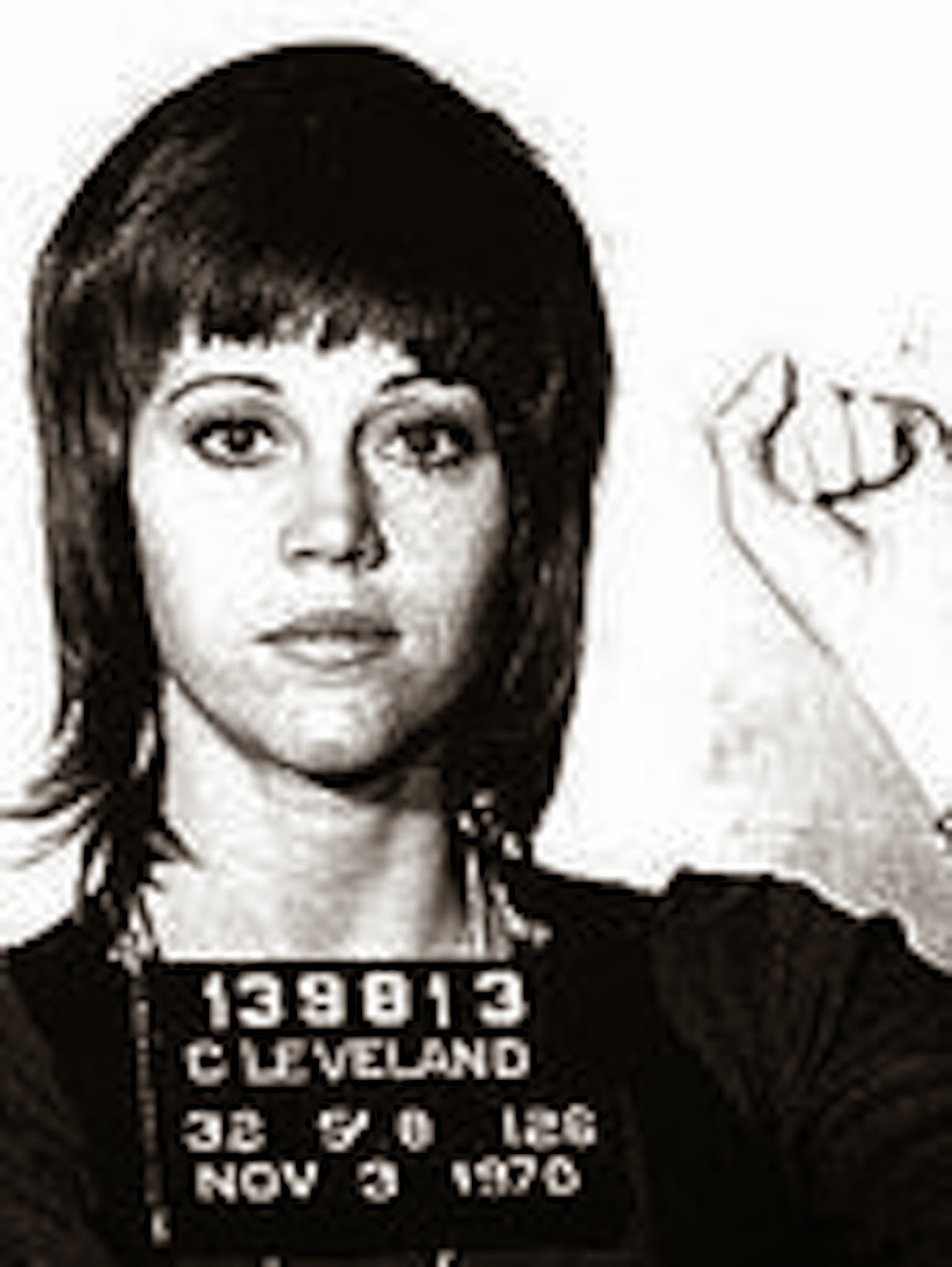
On November 3, 1970 Fonda began a tour of college campuses to raise funds for VVAW. (On that same date, Fonda was arrested for allegedly kicking a U.S. Customs agent; charges were later dropped. In the police mug shot, her raised left hand is clenched in a “Black Power” or “Power to the People” salute).

In 1971 Fonda was the chief financier of VVAW’s Winter Soldier Investigation (WSI), which took place in Detroit from January 31 through February 2 of that year. The largest war crimes tribunal held in the U.S. during the Vietnam War, WSI featured a host of VVAW members who related gruesome stories of atrocities they claimed to have participated in or witnessed in Vietnam; they insisted that rape, torture and murder were standard practices for the American military. In reality, WSI was a continuation of the anti-U.S. war crimes propaganda campaign which had begun in Europe with KGB-sponsored events that were organized before the first American ground troops ever arrived in Vietnam. Several of the WSI discussion panel moderators were radical leaders who had previously met with top North Vietnamese and Vietcong representatives in Hanoi and Paris. Also present were leftist psychiatrists, psychoanalysts and clinicians, who pressured the witnesses to help end the war by publicly confessing their “crimes.”

In July-August 1972 Fonda made her infamous trip to North Vietnam. By this time, over 50,000 Americans had been killed in the war. While there, she posed for pictures on an anti-aircraft gun that had been used to shoot down American planes, and she volunteered to do a radio broadcast from Hanoi. She made approximately eight radio addresses, during which she told American pilots in the area:

“Use of  these bombs or condoning the use of these bombs makes one a war criminal … Examine the reasons given to justify the murder you are being paid to commit … I don’t know what your officers tell you ... but [your] weapons are illegal and that’s not just rhetoric ... The men who are ordering you to use these weapons are war criminals according to international law, and in the past, in Germany and Japan, men who committed these kinds of crimes were tried and executed.”

Fonda also quoted Ho Chi Minh during some of these broadcasts. She referred to President Richard Nixon as a “new-type Hitler,” and advised South Vietnamese soldiers to desert: “You are being used as cannon fodder for U.S. imperialism.”

These radio addresses were aired repeatedly by the North Vietnamese Communists, for whom propaganda was a key tool of psychological warfare; they used the broacasts not only to hearten their own citizens, but also to undermine the American public's will to go forward with the war, and to crush the morale of U.S. and allied forces.

In an effort to explain why she made her broadcasts over Radio Hanoi, Fonda writes in her autobiography that she had mainly wanted to educate U.S. pilots about the great harm their bombing campaigns were inflicting on innocent people. But in fact, most of what Fonda said was of a highly political nature. Many of the statements had been scripted for her by the North Vietnamese. Among her statements were the following (as catalogued by Henry Mark Holzer):

"I want to publicly accuse Nixon here of being a new-type Hitler whose crimes are being unveiled."
"The Vietnamese people will win."
"Nixon is continuing to risk your [American pilots'] lives and the lives of the American prisoners of war . . . in a last desperate gamble to keep his office come November.  How does it feel to be used as pawns?  You may be shot down, you may perhaps even be killed, but for what, and for whom?"
"[President Nixon] defiles our flag and all that it stands for in the eyes of the entire world."
"Knowing who was doing the lying, should you then allow these same people and some liars to define for you who your enemy is?"
"The only way to end the war is for the United States to withdraw all its troops, all its airplanes, its bombs, its generals, its CIA advisors and to stop the support of the . . .  regime in Saigon . . . ."
"There is only one way to stop Richard Nixon from committing mass genocide in the Democratic Republic of Vietnam, and that is for a mass protest . . . to expose his crimes . . . ."
"In 1969-1970 the desertions in the American army tripled. The desertions of the U.S. soldiers almost equaled the desertions from the ARVN army . . . ."
"Perhaps the soldiers . . . who have suffered the most . . . [are] the black soldiers, the brown soldiers, and the red and Asian soldiers."
"Should we be fighting on the side of the people who are, who are murdering innocent people, should we be trying to defend a government in Saigon which is putting in jail tens of thousands of people into the tiger cages, beating them, torturing them . . . . And I don't think . . . that we should be risking our lives or fighting to defend that kind of government."
"We . . . have a common enemy—U. S. imperialism."
"We thank you [the Viet Cong and North Vietnamese] for your brave and heroic fight."
"Nixon's aggression against Vietnam is a racist aggression [and] the American war in Vietnam is a racist war, a white man's war."
"I heard horrifying stories about the treatment of women in the U.S. military. So many women said to me that one of the first things that happens to them when they enter the service is that they are taken to see the company psychiatrist and they are given a little lecture which is made very clear to them that they are there to service the men."
"The POWs appear to be healthy and fit. . . . All of them have called publicly for an end to the war and signed a powerful antiwar letter . . . ."
"A few of them [the POWs] tell me they, too, are against the war and want Nixon to be defeated in the upcoming elections.  They express their fear that if he is reelected, the war will go on and on . . . and that bombs might land on their prison."
"I am asked to convey their [the POWs'] hopes that their families will vote for George McGovern."
"I ask them [POWs] if they feel they have been brainwashed or tortured, and they laugh."
"We read with interest about the growing numbers of you [South Vietnam Army troops] who are understanding the truth and joining with your fellow countrymen to fight for freedom and independence and democracy [i.e., with the Communists]. . . . We think that this is an example of the fact that the democratic, peace-loving, patriotic Vietnamese people want to embrace all Vietnamese people in forgiveness, open their arms to all people who are willing to fight against the foreign intruder.
In addition to the foregoing statements, Fonda also said:


that the Vietnamese people were peasants—leading a peaceful, bucolic life before the Americans came to destroy Vietnam.
that the Vietnamese were seeking only "freedom and independence" — which the United States wanted to prevent them from having.
that the million infantry troops which the United States put into Vietnam, and the Vietnamization program, had failed.
that Patrick Henry's slogan "liberty or death" was not very different from Ho Chi Minh's "Nothing is more valuable than independence and freedom."
that President Nixon had violated the 1954 Geneva Accords.
that the United States must get out of South Vietnam and "cease its support for the . . . Thieu regime."
that American troops were fighting for ESSO, Shell and Coca-Cola.
that the soldiers of the South Vietnamese army were "being sent to fight a war that is not in [their] interests but is in the interests of the small handful of people who have gotten rich and hope to get richer off this war and the turning of [their] country into a neocolony of the United States."
that American soldiers in Vietnam had discovered "that their officers were incompetent, usually drunk . . . ."
that she had recently talked to "a great many of these guys [black American soldiers] and they all expressed their recognition of the fact that this is a white man's war, a white businessman's war, that they don't feel it's their place to kill other people of color when at home they themselves are oppressed and prevented from determining their own lives."
Such statements could have had only one purpose: to provide aid and comfort to America's Communist enemy. Fonda's propaganda efforts played a major role in prolonging the war and increasing the death toll. As North Vietnamese Colonel Bui Tin explained in a postwar interview with The Wall Street Journal, the American antiwar movement "was essential to our strategy. Support for the war from our rear [China] was completely secure while the American rear was vulnerable. Every day our leadership would listen to world news over the radio at 9 a.m. to follow the growth of the American antiwar movement. Visits to Hanoi by people like Jane Fonda . . . gave us confidence that we should hold on in the face of battlefield reverses."

As Henry Mark Holzer details, Fonda, while in Hanoi, also spent time doing the following:

Touring such North Vietnamese sites as the so-called "War Crimes" museum, a hospital, a textile center, and numerous populated areas -- always in the company of North Vietnamese civilian and military officials as well as members of the international press -- and there making pro-Communist and anti-American propaganda statements.
Making pro-Communist, anti-American propaganda statements to a French journalist, to reporters at a press conference in Hanoi, and to North Vietnamese Vice Premier Nguyen Duy Trinh
Posing -- in the company of Communist civilian and military officials and members of the international press -- in the control seat of a North Vietnamese anti-aircraft gun, pretending to take aim on an imaginary American aircraft
As evidenced by some of the quotes above, Fonda visited American prisoners of war and reported (falsely) that they had not been tortured. Consider the account of Michael Benge, a civilian advisor captured by the NLF in 1968 and held as a POW for five years, who writes:

“When Jane Fonda was in Hanoi, I was asked by the camp communist political officer if I would be willing to meet with her. I said yes, for I would like to tell her about the real treatment we POWs were receiving, which was far different from the treatment purported by the North Vietnamese, and parroted by Jane Fonda, as ‘humane and lenient.’  Because of this, I spent three days on a rocky floor on my knees with outstretched arms with a piece of steel re-bar placed on my hands, and beaten with a bamboo cane every time my arms dipped.”


Former POW David Hoffman, whose plane was shot down over North Vietnam in 1971, also says that he was tortured because of Fonda’s visit to Hanoi:

“The torture resulted in a permanent injury that plagues me to this day,” explains Hoffman, whose arm is now disfigured because of the brutal treatment he received from communist guards at his POW camp. “When Jane Fonda turned up, she asked that some of us come out and talk with her. No one wanted to. The guards got very upset, because they sensed the propaganda value of a famous American war protestor proving how well they were treating us. A couple of guards came to my cell and ordered me out. I resisted, and they got violently angry.  My arm had been broken when I was shot down, and the Vietnamese broke it a second time.  It had not healed well, and they knew it caused me great pain. They twisted it.  Excruciating pain ripped through my body.  Still I resisted and they got more violent, hitting me and shouting, ‘You must go!’…I was dragged out to see Fonda.  I decided to play the role.  I knew if I didn’t, not only would I suffer -- but the other guys would be tortured or beaten or worse.”

When Fonda returned to the U.S., she told college students, “I bring greetings from our Vietnamese brothers and sisters,” and she lamented the war damage that she had seen in North Vietnam -- inflicted, she said, by U.S. forces. She also sported a necklace given to her by the North Vietnamese Communists, made from the melted parts of a U.S. aircraft they had shot down.

Whenever stories about POWs getting tortured emerged, Fonda called them lies. When the POWs began coming home in 1973 and their accounts of torture began to gain credence, Fonda called the returning soldiers “liars, hypocrites, and pawns.”  "Tortured men do not march smartly off planes, salute the flag, and kiss their wives," she said.  "They are liars.  I also want to say that these men are not heroes."

Even when the U.S. pulled its troops almost entirely out of Vietnam in 1973, Fonda and her new husband Tom Hayden were not satisfied; together they formed the Indochina Peace Campaign (IPC), which continued to mobilize radicals across the United States after the 1973 Paris Peace Agreement, at a time when most antiwar organizations had either closed down or moved on to other causes.  The IPC worked tirelessly to cut American aid to the governments in Saigon and Phnom Penh and help the North Vietnamese Communists and the Cambodian Khmer Rouge overthrow them.

Fonda and Hayden also returned to Hanoi and went on to the “liberated zones” of South Vietnam (areas the Communists had conquered) to shoot the documentary Introduction to the Enemy, a propaganda piece depicting the North Vietnamese as peaceful patriots who, despite years of war and bloodshed, did not hate Americans and planned to create an ideal new society based on justice and equality.

Fonda would never express regrets or utter a word of protest when more than two million Indochinese peasants were slaughtered after American aid was cut off and the communists took complete control of South Vietnam and Cambodia in 1975. In fact, she refused to join folk singer and fellow antiwar activist Joan Baez in her protest against North Vietnam’s incarceration of more than 100,000 South Vietnamese because, as she told the National Press Club on September 26, 1979, she was unable to prove the veracity of the charges against the new communist regime.

Fonda’s activism was not limited to protests against American military involvement in Southeast Asia. She was also immersed in radical chic causes like the American Indian movement and Black Power.  When Alcatraz Island was taken over by 79 American Indians on November 20, 1969, Fonda visited the site to show her solidarity with their occupation.

Fonda was also a strong supporter of Huey Newton and the Black Panthers, calling the latter “our revolutionary vanguard.” “We must support them with love, money, propaganda and risk,” she said. Fonda claimed that Newton was the only man she would trust to lead America (a claim she would later recant as having been “naïve and utterly wrong”), and also campaigned for the incarcerated Angela Davis and other black “political prisoners.”

Fonda spoke frequently and proudly about her radicalism, saying in 1970: “Revolution is an act of love; we are the children of revolution, born to be rebels. It runs in our blood.” In 1972 she declared, “I am not a do-gooder. I am a revolutionary. A revolutionary woman.”

Two weeks after the opening of her 1979 movie The China Syndrome (which depicted an accident at a nuclear energy plant), there was a real nuclear accident at Three Mile Island causing small amounts of radioactivity to escape into the atmosphere.  Fonda called this “the most shocking synchronicity between real life catastrophe and movie fiction ever to have occurred,” and took off with her husband on a 52-city anti-nuclear tour. Joining Fonda and Hayden on tour were leftwing stalwarts Bonnie Raitt and Jackson Brown.

Another pet cause of Fonda (and of her ex-husband Ted Turner) is population control. Fonda served as President Bill Clinton’s special “good-will” ambassador to the United Nations Population Fund, and gave a speech at the UN where she complained: “Our species alone co-opts, consumes or eliminates 40% of the Earth's … energy … We must fight to ensure universal access to family planning ... backed up with safe abortion.”

In 2003 Fonda received Planned Parenthood’s Margaret Sanger Award for her work to promote population control and taxpayer-funded abortion-on-demand. The following year, Ted Turner won the same award. Fonda and Turner also share a passionate devotion to the tenets of radical environmentalism. In particular, Fonda supports the Environmental Media Association.

In 1999 Fonda was named one of the “100 Most Important Women in the 20th Century” by ABC News and Ladies Home Journal. It was later revealed that four of the seven women who had placed Fonda on the list had also worked to prevent President Clinton from being impeached.

Over the years, Fonda has given campaign contributions to such political figures as Hillary Clinton, Barbara Boxer, Tom Daschle, Max Cleland, Cynthia McKinney and Nancy Pelosi. She also gave $100,000 to the Al Gore recount effort in Florida in 2000 (following the election controversy), $5,000 to NARAL Pro-Choice America, and $4,000 to the MoveOn political action committee.

Fonda continues to participate in the antiwar/peace movement, particularly with regard to the Middle East and the War on Terror. She visited a Palestinian refugee camp and was scheduled to meet with Yasser Arafat, though the meeting never occurred. And just days after terrorists had killed some 3,000 people on 9/11, Fonda said that instead of retaliation, the U.S. should try to understand the “underlying reasons” behind the murderous attacks.

In 2003 Fonda made clear her opposition to the war in Iraq, stating: “What's it going to mean for [U.S.] stability as a nation, for terrorism, for the economy I can't imagine. I think the entire world is going to be united against us.” She was also critical of her fellow American citizens: “I don’t know if a country where the people are so ignorant of reality and of history, if you can [call] that a free world.” To express her opposition to the war, Fonda signed on to the “Not in Our Name” campaign, which was directed by C. Clark Kissinger, a longtime Maoist activist and member of the Revolutionary Communist Party.

In 2004 Fonda, in a joint effort with Vagina Monologues playwright Eve Ensler, initiated “Vaginas Vote,” a pro-John Kerry get-out-the-vote campaign that sponsored events in more than 30 states. A Fonda press release promoting a September 13th “Vaginas Vote” rally in New York stated, “Vaginas Vote, Chicks Rock. ... [O]rganizers are using the power of arts and activism to motivate and inspire all women -- especially young women -- to raise their voices and get out the vote to end violence against women and girls.”

The “Vagina's Vote” event was aimed at persuading young women to vote in favor of John Kerry in the 2004 Presidential election, the implication being that another Bush term would mean higher levels of violence against women than would a Kerry presidency. At the aforementioned New York rally, Ms. Ensler said to the attendees: “Are there are any registered vaginas in the house? . . . Step into your vaginas and get the vagina vote out.” Among those in the audience were Susan Sarandon, Gloria Steinem, Democratic Rep. Jan Schakowsky, and Jesse Jackson.

In April 2005 Fonda released her autobiography My Life So Far, in which she discussed, among many topics, her infamous trip to North Vietnam. In an interview to promote the book, Fonda described her visit with the Viet Cong as a “betrayal” of American forces and of the “country that gave me privilege.”  She called it the “largest lapse of judgment that I can even imagine.”  However, she said she did not regret having met with American POWs in North Vietnam or having made propaganda broadcasts on Radio Hanoi. “Our government was lying to us and men were dying because of it, and I felt I had to do anything that I could to expose the lies and help end the war,” she said.

In September 2005 Fonda made two appearances with British Member of Parliament George Galloway (who had been on Saddam Hussein's payroll and had illegally received about $585,000 in annual profits from Iraq's exports under the Oil-For-Food program) during his twelve-city speaking tour of the U.S., where he condemned America's war efforts in Iraq as both illegal and immoral. (Fonda was originally scheduled to make eight appearances with Galloway, but changed her plans so as to avoid drawing attention away from Cindy Sheehan's anti-war tour that was in progress at the time.)

In a 2011 biography of Jane Fonda, author Patricia Bosworth revealed a lifelong lament by the actress: “My biggest regret” Bosworth quotes Fonda as having said during a “feminist consciousness-raising session,” “is I never got to f*** Che Guevara.”

In 2012, Fonda acknowledged that she had used bad judgment in posing for the 1972 photos aboard the North Vietnamese anti-aircraft gun -- though she was careful to defend her decision to visit Hanoi: “I did not, have not, and will not say that going to North Vietnam was a mistake. I have apologized only for some of the things that I did  there, but I am proud that I went.”

In July-August 1972 Fonda made her infamous trip to North Vietnam. By this time, over 50,000 Americans had been killed in the war. While there, she posed for pictures on an anti-aircraft gun that had been used to shoot down American planes, and she volunteered to do a radio broadcast from Hanoi. She made approximately eight radio addresses, during which she told American pilots in the area:

“Use of these bombs or condoning the use of these bombs makes one a war criminal … Examine the reasons given to justify the murder you are being paid to commit … I don’t know what your officers tell you … but [your] weapons are illegal and that’s not just rhetoric … The men who are ordering you to use these weapons are war criminals according to international law, and in the past, in Germany and Japan, men who committed these kinds of crimes were tried and executed.”

Fonda also quoted Ho Chi Minh during some of these broadcasts. She referred to President Richard Nixon as a “new-type Hitler,” and advised South Vietnamese soldiers to desert: “You are being used as cannon fodder for U.S. imperialism.”

These radio addresses were aired repeatedly by the North Vietnamese Communists, for whom propaganda was a key tool of psychological warfare; they used the broacasts not only to hearten their own citizens, but also to undermine the American public’s will to go forward with the war, and to crush the morale of U.S. and allied forces.

In an effort to explain why she made her broadcasts over Radio Hanoi, Fonda writes in her autobiography that she had mainly wanted to educate U.S. pilots about the great harm their bombing campaigns were inflicting on innocent people. But in fact, most of what Fonda said was of a highly political nature. Many of the statements had been scripted for her by the North Vietnamese. Among her statements were the following (as catalogued by Henry Mark Holzer):

“I want to publicly accuse Nixon here of being a new-type Hitler whose crimes are being unveiled.”
“The Vietnamese people will win.”
“Nixon is continuing to risk your [American pilots'] lives and the lives of the American prisoners of war . . . in a last desperate gamble to keep his office come November. How does it feel to be used as pawns? You may be shot down, you may perhaps even be killed, but for what, and for whom?”
“[President Nixon] defiles our flag and all that it stands for in the eyes of the entire world.”
“Knowing who was doing the lying, should you then allow these same people and some liars to define for you who your enemy is?”
“The only way to end the war is for the United States to withdraw all its troops, all its airplanes, its bombs, its generals, its CIA advisors and to stop the support of the . . . regime in Saigon . . . .”
“There is only one way to stop Richard Nixon from committing mass genocide in the Democratic Republic of Vietnam, and that is for a mass protest . . . to expose his crimes . . . .”
“In 1969-1970 the desertions in the American army tripled. The desertions of the U.S. soldiers almost equaled the desertions from the ARVN army . . . .”
“Perhaps the soldiers . . . who have suffered the most . . . [are] the black soldiers, the brown soldiers, and the red and Asian soldiers.”
“Should we be fighting on the side of the people who are, who are murdering innocent people, should we be trying to defend a government in Saigon which is putting in jail tens of thousands of people into the tiger cages, beating them, torturing them . . . . And I don’t think . . . that we should be risking our lives or fighting to defend that kind of government.”
“We . . . have a common enemy—U. S. imperialism.”
“We thank you [the Viet Cong and North Vietnamese] for your brave and heroic fight.”
“Nixon’s aggression against Vietnam is a racist aggression [and] the American war in Vietnam is a racist war, a white man’s war.”
“I heard horrifying stories about the treatment of women in the U.S. military. So many women said to me that one of the first things that happens to them when they enter the service is that they are taken to see the company psychiatrist and they are given a little lecture which is made very clear to them that they are there to service the men.”
“The POWs appear to be healthy and fit. . . . All of them have called publicly for an end to the war and signed a powerful antiwar letter . . . .”
“A few of them [the POWs] tell me they, too, are against the war and want Nixon to be defeated in the upcoming elections. They express their fear that if he is reelected, the war will go on and on . . . and that bombs might land on their prison.”
“I am asked to convey their [the POWs'] hopes that their families will vote for George McGovern.”
“I ask them [POWs] if they feel they have been brainwashed or tortured, and they laugh.”
“We read with interest about the growing numbers of you [South Vietnam Army troops] who are understanding the truth and joining with your fellow countrymen to fight for freedom and independence and democracy [i.e., with the Communists]. . . . We think that this is an example of the fact that the democratic, peace-loving, patriotic Vietnamese people want to embrace all Vietnamese people in forgiveness, open their arms to all people who are willing to fight against the foreign intruder.
In addition to the foregoing statements, Fonda also said:


that the Vietnamese people were peasants—leading a peaceful, bucolic life before the Americans came to destroy Vietnam.
that the Vietnamese were seeking only “freedom and independence” — which the United States wanted to prevent them from having.
that the million infantry troops which the United States put into Vietnam, and the Vietnamization program, had failed.
that Patrick Henry’s slogan “liberty or death” was not very different from Ho Chi Minh’s “Nothing is more valuable than independence and freedom.”
that President Nixon had violated the 1954 Geneva Accords.
that the United States must get out of South Vietnam and “cease its support for the . . . Thieu regime.”
that American troops were fighting for ESSO, Shell and Coca-Cola.
that the soldiers of the South Vietnamese army were “being sent to fight a war that is not in [their] interests but is in the interests of the small handful of people who have gotten rich and hope to get richer off this war and the turning of [their] country into a neocolony of the United States.”
that American soldiers in Vietnam had discovered “that their officers were incompetent, usually drunk . . . .”
that she had recently talked to “a great many of these guys [black American soldiers] and they all expressed their recognition of the fact that this is a white man’s war, a white businessman’s war, that they don’t feel it’s their place to kill other people of color when at home they themselves are oppressed and prevented from determining their own lives.”
Such statements could have had only one purpose: to provide aid and comfort to America’s Communist enemy. Fonda’s propaganda efforts played a major role in prolonging the war and increasing the death toll. As North Vietnamese Colonel Bui Tin explained in a postwar interview with The Wall Street Journal, the American antiwar movement “was essential to our strategy. Support for the war from our rear [China] was completely secure while the American rear was vulnerable. Every day our leadership would listen to world news over the radio at 9 a.m. to follow the growth of the American antiwar movement. Visits to Hanoi by people like Jane Fonda . . . gave us confidence that we should hold on in the face of battlefield reverses.”

… When Fonda returned to the U.S., she told college students, “I bring greetings from our Vietnamese brothers and sisters,” and she lamented the war damage that she had seen in North Vietnam — inflicted, she said, by U.S. forces. She also sported a necklace given to her by the North Vietnamese Communists, made from the melted parts of a U.S. aircraft they had shot down.

Whenever stories about POWs getting tortured emerged, Fonda called them lies. When the POWs began coming home in 1973 and their accounts of torture began to gain credence, Fonda called the returning soldiers “liars, hypocrites, and pawns.” “Tortured men do not march smartly off planes, salute the flag, and kiss their wives,” she said. “They are liars. I also want to say that these men are not heroes.”

… Fonda and Hayden also returned to Hanoi and went on to the “liberated zones” of South Vietnam (areas the Communists had conquered) to shoot the documentary Introduction to the Enemy, a propaganda piece depicting the North Vietnamese as peaceful patriots who, despite years of war and bloodshed, did not hate Americans and planned to create an ideal new society based on justice and equality.
If you follow the link above, you can also read about how her visit directly led to the torture of American POWs. Jim Hoft has pictures of her time at Hanoi, too.

She’s encouraging people to read what really happened? Well, that’s what we’re doing, and I see one thing. I see that Jane Fonda is a traitor, who without a doubt provided aid and comfort to our enemy during the Vietnam War, repeatedly. She provided propaganda for the North Vietnamese. She caused the torture of our POWs and the turned around and slandered them when they got back. If treason is defined by “providing aid and comfort to our enemies”, then Jane Fonda is surely a traitor. And that isn’t some “right-wing myth”. It’s a FACT.

THIS IS MY RESEARCH YOU DECIDE TRAITOR OR NOT!


Tuesday, September 17, 2013

Navy Yard Shooting Rampage


As I was at work on my very first day this is the news that broke. I was stunned. Needless to say in my mind  I wondered where will a individual or several people strike next? It can be anyone, anywhere. Could it be in the hospital where I work, on mass transit, and to think I just left the area where this killer stuck. I was in Baltimore, but I know exactly where this went down. There is so much madness in the world today, I pray God please let it stop. I know this news is coming a little late for me since I have been working, but please pray for the families of the deceased and the survivors.  


A defense-industry employee used his pass to get into the Washington Navy Yard and went on a deadly shooting rampage Monday, spraying bullets in the hallway and firing from a balcony on workers in an atrium below. Thirteen people were killed, including the gunman.

The motive for the assault — the deadliest shooting on a military installation in the U.S. since the tragedy at Fort Hood, Texas, in 2009 — was a mystery, investigators said.

Mayor Vincent Gray said there was no indication it was a terrorist attack, but he added that the possibility had not been ruled out.

"This is a horrific tragedy," he said.

The onslaught at a single building at the highly secure Navy Yard unfolded about 8:20 a.m. in the heart of the nation's capital, less than four miles from the White House and two miles from the Capitol.

It put all of Washington on edge and raised the specter of another well-coordinated terrorist strike — or another attack from within, like Fort Hood.

The gunman, Aaron Alexis, a 34-year-old information technology employee and former Navy reservist whose last known address was in Fort Worth, Texas, died after a running gunbattle inside the building with police, investigators said.

He carried three weapons: an AR-15 assault rifle, a shotgun, and a handgun that he took from a police officer at the scene, according to two federal law enforcement officials who spoke on condition of anonymity because they were not authorized to discuss the investigation.

For much of the day, authorities said they were looking for a possible second attacker who may have been disguised in an olive-drab military-style uniform.

But by late Monday night, they said they were convinced the shooting was the work of a lone gunman, and the lockdown around the area was eased.

"We do now feel comfortable that we have the single and sole person responsible for the loss of life inside the base today," Washington Police Chief Cathy Lanier said.

President Barack Obama lamented yet another mass shooting in the U.S. that he said took the lives of American "patriots." He promised to make sure "whoever carried out this cowardly act is held responsible."

The FBI took charge of the investigation.

The attack came four years after Army psychiatrist Maj. Nidal Hasan killed 13 people at Fort Hood in what he said was an effort to save the lives of Muslims overseas. He was convicted last month and sentenced to death.

In addition to those killed at the Navy Yard, eight people were hurt, including three who were shot and wounded, according to the mayor. Those three were a police officer and two female civilians, authorities said. They were all expected to survive.

The dead ranged in age from 46 to 73, according to the mayor. A number of the victims were civilian employees and contractors, rather than active-duty military personnel, the police chief said.

At the time of the rampage, Alexis was an employee with The Experts, a company that was a Defense Department subcontractor on a Navy-Marine Corps computer project, authorities said.

Valerie Parlave, head of the FBI's field office in Washington, said Alexis had access to the Navy Yard as a defense contractor and used a valid pass.

Alexis had been a full-time Navy reservist from 2007 to early 2011, leaving as a petty officer third class, the Navy said. It did not say why he left. He had been an aviation electrician's mate with a unit in Fort Worth.

A convert to Buddhism who grew up in New York City, Alexis had had run-ins with the law over shooting incidents in 2004 and 2010 in Fort Worth and Seattle and was portrayed in police reports as seething with anger.

The Washington Navy Yard is a sprawling, 41-acre labyrinth of buildings and streets protected by armed guards and metal detectors, and employees have to show their IDs at doors and gates. More than 18,000 people work there.

The rampage took place at Building 197, the headquarters for Naval Sea Systems Command, which buys, builds and maintains ships and submarines. About 3,000 people work at headquarters, many of them civilians.

Witnesses on Monday described a gunman opening fire from a fourth-floor overlook, aiming down on people on the main floor, which includes a glass-walled cafeteria. Others said a gunman fired at them in a third-floor hallway.

Patricia Ward, a logistics-management specialist, said she was in the cafeteria getting breakfast.

"It was three gunshots straight in a row — pop, pop, pop. Three seconds later, it was pop, pop, pop, pop, pop, so it was like about a total of seven gunshots, and we just started running," Ward said.

Todd Brundidge, an executive assistant with Navy Sea Systems Command, said he and co-workers encountered a gunman in a long hallway on the third floor. The gunman was wearing all blue, he said.

"He just turned and started firing," Brundidge said.

Terrie Durham, an executive assistant with the same agency, said the gunman fired toward her and Brundidge.

"He aimed high and missed," she said. "He said nothing. As soon as I realized he was shooting, we just said, 'Get out of the building.'"

As emergency vehicles and law enforcement officers flooded the streets, a helicopter hovered, nearby schools were locked down and airplanes at Reagan National Airport were grounded so they would not interfere with law-enforcement choppers.

Security was tightened at other federal buildings. Senate officials shut down their side of the Capitol. The House remained open.

In the confusion, police said around midday that they were searching for two accomplices who may have taken part in the attack — one carrying a handgun and wearing a tan Navy-style uniform and a beret, the other armed with a long gun and wearing an olive-green uniform. Police said it was unclear if the men were members of the military.

But as the day wore, police dropped one person and then the other as suspects. As tensions eased, Navy Yard employees were gradually released from the complex, and children were let out of their locked-down schools.

Adm. Jonathan Greenert, chief of naval operations, was at the base at the time the shooting began but was moved unharmed to a nearby military installation.

Anxious relatives and friends of those who work at the complex waited to hear from loved ones.

Tech Sgt. David Reyes, who works at Andrews Air Force Base, said he was waiting to pick up his wife, Dina, who was under lockdown in a building next to where the shooting happened. She sent him a text message.

"They are under lockdown because they just don't know," Reyes said. "They have to check every building in there, and they have to check every room and just, of course, a lot of rooms and a lot of buildings."


Navy Yard shooting suspect Aaron Alexis suffered a host of mental health issues, including paranoia, a sleep disorder and hearing voices in his head.

Aaron Alexis seems a study in contradictions: a former Navy reservist, a Defense Department contractor, a convert to Buddhism who was taking an online course in aeronautics. But he also had flashes of temper that led to run-ins with police over shootings in Seattle and Fort Worth, Texas.

A profile began to emerge Monday of the man authorities identified as the gunman in a mass shooting at the Navy Yard in Washington, D.C., that left 13 people dead, including the 34-year-old man. While some neighbors and acquaintances described him as "nice," his father once told detectives in Seattle that his son had anger management problems related to post-traumatic stress brought on by the terrorist attacks of Sept. 11, 2001. He also complained about the Navy and being a victim of discrimination.

FBI: Navy Yard shooter had shotgun, handguns
10 hr ago 0:56 Views: 2k AP Online Video
U.S. law enforcement officials told The Associated Press that Alexis had been suffering a host of serious mental issues, including paranoia and a sleep disorder. He also had been hearing voices in his head, the officials said. Alexis had been treated since August by the Veterans Administration for his mental problems, the officials said. They spoke on condition of anonymity because the criminal investigation in the case was continuing.

The officials also said there has been no connection to international or domestic terrorism, and investigators have found no manifesto or other writings suggesting a political or religious motivation.

The Navy had not declared him mentally unfit, which would have rescinded a security clearance Alexis had from his earlier time in the Navy Reserves.

U.S. officials say Alexis had a string of misconduct problems during his nearly three years in the military, but he received an honorable discharge.

The officials say he had incidents of insubordination and disorderly conduct and was sometimes absent from work without authorization. The offenses occurred mainly when he was serving in Texas from 2008 to 2011 and were enough to prompt Navy officials to grant him an early discharge through a special program for enlisted personnel.

Officials said the bad conduct was enough to make it clear Alexis would not be a good sailor, but not enough to warrant a general or less-than-honorable discharge.

Family members told investigators that Alexis was being treated for his mental health issues.

Washington Navy Yard shooting: Link button to Washington Navy Yard shooting galleryReuters: Jason Reed
Click image to see: Washington Navy Yard shooting gallery
At the time of the shootings, he worked for The Experts, a subcontractor on an HP Enterprise Services contract to refresh equipment used on the Navy Marine Corps Intranet network.

His life over the past decade has been checkered.

Alexis lived in Seattle in 2004 and 2005, according to public documents. In 2004, Seattle police said Alexis was arrested for shooting out the tires of another man's vehicle in what he later described to detectives as an anger-fueled "blackout." According to an account on the department's website, two construction workers had parked their Honda Accord in the driveway of their worksite, next to a home where Alexis was staying. The workers reported seeing a man, later identified by police as Alexis, walk out of the home next to their worksite, pull a gun from his waistband and fire three shots into the rear tires of their Honda before he walked slowly back to his home.

When detectives interviewed workers at the construction site, they told police Alexis had stared at construction workers at the job site daily for several weeks prior to the shooting. The owner of the construction business told police he believed Alexis was angry over the parking situation around the site.

Police eventually arrested Alexis, searched his home, found a gun and ammunition in his room, and booked him into the King County Jail for malicious mischief.

According to the police account, Alexis told detectives he perceived he had been "mocked" by construction workers the morning of the incident. Alexis also claimed he had an anger-fueled "blackout," and could not remember firing his gun at the Honda until an hour after the incident.

Alexis also told police he was present during "the tragic events of Sept. 11, 2001" and described "how those events had disturbed him."

Then, on May 5, 2007, he enlisted in the Navy reserves, serving through 2011, according to Navy spokeswoman Lt. Megan Shutka.

Shutka said he received the National Defense Service Medal and the Global War on Terrorism Service Medal during his stint in the reserves. Both are medals issued to large numbers of service members who served abroad and in the United States since the 9/11 attacks. Alexis' last assignment was as aviation electricians mate 3rd class at the Naval Air Station Joint Reserve Base in Fort Worth, Shutka said.

Navy yard shooting: Everything we know so far
1 day ago 1:17 Views: 3k NowThis News
It was while he was still in the reserves that a neighbor in Fort Worth reported she had been nearly struck by a bullet shot from his downstairs apartment.

In September 2010, Fort Worth police questioned Alexis about the neighbor's report. He admitted to firing his weapon but said he was cleaning his gun when it accidentally discharged. He said he did not call the police because he didn't think the bullet went through to the other apartment. The neighbor told police she was scared of Alexis and felt he fired intentionally because he had complained about her making too much noise.

Alexis was arrested on suspicion of discharging a firearm within city limits but Tarrant County district attorney's spokeswoman Melody McDonald Lanier said the case was not pursued after it was determined the gun discharged accidentally.

After leaving the reserves, Alexis worked as a waiter and delivery driver at the Happy Bowl Thai restaurant in White Settlement, a suburb of Fort Worth, according to Afton Bradley, a former co-worker. The two overlapped for about eight months before Alexis left in May, Bradley said.

Having traveled to Thailand, Alexis learned some Thai and could speak to Thai customers in their native language.

"He was a very nice person," Bradley said in a phone interview. "It kind of blows my mind away. I wouldn't think anything bad at all."

A former acquaintance, Oui Suthametewakul, said Alexis lived with him and his wife from August 2012 to May 2013 in Fort Worth, but that they had to part ways because he wasn't paying his bills. Alexis was a "nice guy," Suthametewakul said, though he sometimes carried a gun and would frequently complain about being the victim of discrimination.

Suthametewakul said Alexis had converted to Buddhism and prayed at a local Buddhist temple.

"We are all shocked. We are nonviolent. Aaron was a very good practitioner of Buddhism. He could chant better than even some of the Thai congregants," said Ty Thairintr, a congregant at Wat Budsaya, a Buddhist temple in Fort Worth.

Thairintr said Alexis told him he was upset with the Navy because "he thought he never got a promotion because of the color of his skin. He hated his commander."

As Thairintr and others at the temple understood, Alexis took a job as a contractor and he indicated to them he was going to go to Virginia. He last saw him five weeks ago.

"He was a very devoted Buddhist. There was no tell-tale sign of this behavior," Thairintr said.

In the early 2000s, before he moved to Seattle, Alexis lived with his mother in an apartment in Queens, N.Y., said Gene Demby, of Philadelphia, who said he dated one of Alexis' younger sisters at the time. He said Alexis and his two younger sisters had a difficult relationship with their father, who divorced their mother in the mid-1990s.

"I wouldn't call him nice, but he seemed harmless, if really awkward," said Demby, the lead writer for NPR's Code Switch blog about race and culture. "He was insecure. He was like a barbershop conspiracy theorist, the kind of guy who believes he's smarter than everyone else. He also was kind of like perpetually aggrieved, but not megalomaniacal or delusional."

Embry-Riddle Aeronautical University, which offers online courses in aviation and aerospace, confirmed that Alexis was enrolled as an online student via its Fort Worth campus, started classes in July 2012 and was pursuing a bachelor's of science in aeronautics.