
This is something I have really wondered about for years, and so I am doing research on now. As they say inquiring minds want to know. But those who know me well will tell you if I do not know about something, a topic in conversation parse I will do research to find the definition and how to use the word correctly, same as with topics I have no knowledge of due to my age. My mama was a big Jane Fonda fan, and I remember daddy saying things like I see you are watching that traitor again. I know I speak of my hippie parents, but daddy is as patriotic as they come. I know he was not in any war or branch of service, but daddy was declared 4-F for reasons I will not discuss since they are private matters. No daddy never went to Canada to dodge the draft., but he did inhale. But, my daddy was not old enough to fight in Vietnam.
I was recently reading news segments that pop up on my IPad and there is was in black and white was Jane Fonda a traitor? Since I never had daddy explain his outrage for the woman, I called just to talk about this subject. My daddy said that back then he to believed in peace, but if you are called to defend your country you didn't ask questions you just went and it should be a honor to serve your country. He still says today that the US was fighting a war and that no one knew why? No one knew why the viet-cong was our enemy. It was not like other wars or like when our troops were deployed after 911. He says that they lost a lot of good men that had no idea of the mission they were on. He believes that if there was a said mission and strategies by our government that all those lives would not have been lost. To hear daddy tell it the troops were sat down in rice paddies and left for dead basically. This is not my opinion since I wasn't even born yet.
But, here goes what I know from daddy on Jane Fonda and the rest will be all research. My daddy said that movies stars use to go for I think he said USO events to entertain the soldiers. I may have those initials wrong since google came up with the US Open? Anyway Jane Fonda went to Vietnam and when she was greeted by US soldiers she spit in there faces and called them murders, only to turn to the wounded viet-cong with compassion and mercy. With her politics and actions afterwards she was deemed a traitor.

Jane Fonda committed treason, and that’s NOT a myth
Of course, what Jane Fonda did was far worse than just rubbing some elbows. She actually committed treasonous activities. Now, however, she’d like you to believe that it’s all just a right-wing myth.
JANE FONDA: No, it’s about the myth, you know, why it is that 300 people went to North Vietnam, people, many people before me, why me, why have they created this myth? You know, when I came back from North Vietnam, there was maybe a quarter of an inch of media about it in the New York Times. Nobody made any big deal out of it. It was created, and some people are stuck-
LARRY KING: By critics?
FONDA: By right wingers. There are some people who are like stuck there, you know, they’re still stuck in the past. I always want to say, “Get a life,” or, you know, “Read what really happened,” you know. The myths are now true.
Of course, anyone with any knowledge of the Vietnam War knows exactly how big a part Jane Fonda played in it. They know of her treason. But just in case some of you don’t,

Film actress
Visited Hanoi during the Vietnam War, at which time she accused American soldiers of acting as “war criminals”
“If you understood what communism was, you would hope, you would pray on your knees that we would some day become communist. . . . I, a socialist, think that we should strive toward a socialist society, all the way to communism.”
Married Tom Hayden and Ted Turner
Co-founded (with Tom Hayden) the Indochina Peace Campaign, which worked tirelessly to cut American aid to the governments in Saigon and Phnom Penh and help the North Vietnamese Communists and the Cambodian Khmer Rouge overthrow them

Born Jane Seymour Fonda on December 21, 1937 in New York City, Jane Fonda is the daughter of actor Henry Fonda and the sister of actor Peter Fonda. She was named after Lady Jane Seymour, the third wife of King Henry VIII. Her father was an outspoken opponent of the House Un-American Activities Committee. Her mother, Frances Seymour Brokaw, slit her own throat when Jane was just 12 years old. Young Jane, told that her mother had died of a heart attack, found out about her mother’s graphic suicide years later in a movie magazine.
As a young adult, Fonda attended Vassar College and struggled with bulimia. Following her graduation, she moved to New York City and studied acting at Lee Strasberg’s Actors’ Studio. After doing some stage work, she made her big-screen debut in the 1960 film Tall Story. She has had a most successful acting career, with seven Academy Award nominations and two Oscar wins. Her movie credits include Cat Ballou (1965), Barefoot in the Park (1967), Barbarella (1968), They Shoot Horses, Don’t They? (1969), Klute (1971), Julia (1977), Coming Home (1978), The China Syndrome (1979), 9 to 5 (1980), and On Golden Pond (1981). In the 1980s Fonda launched a new and highly successful career as the star and producer of exercise videos and books.

Fonda was married to French director Roger Vadim from 1965 to 1973, and it was while living in France that she was introduced to French communists who would initiate her into political activism. Together she and Vadim had a daughter, Vanessa, so named because Fonda admired actress Vanessa Redgrave’s radical politics. Fonda became pregnant by activist Tom Hayden in 1972, and the two were married in 1973 (they would divorce in 1990). Fonda and Hayden named their newborn son Troy (originally spelled "Troi") after a Viet Cong hero, Nguyen Van Troi, who was executed by the South Vietnamese government after attempting to assassinate Secretary of Defense Robert McNamara in 1963. (Fonda’s third marriage, to television mogul Ted Turner, would last from 1991 to 2001.)
Fonda’s affinity for communism served as a backdrop for her intense anti-Vietnam War activities. By 1970 she was telling American college students: “If you understood what communism was, you would hope, you would pray on your knees that we would some day become communist. . . . I, a socialist, think that we should strive toward a socialist society, all the way to communism.” The dual villains of Southeast Asian conflicts were, in her view, "U.S. imperialism" and "a white man's racist aggression."
In April 1970, Fonda and actor Donald Sutherland formed “FTA” (which meant, depending upon the source, either “Free the Army” or “F*ck the Army”), an anti-war, quasi-USO road show billed as “political vaudeville” that toured military towns along the West Coast and throughout the Pacific.
Fonda also worked with Vietnam Veterans Against the War (VVAW), serving as Honorary National Coordinator for a 1970 rally which that group organized in Valley Forge, Pennsylvania. Vietnam veteran and future Democratic presidential nominee John Kerry was also involved in organizing the rally (he and Fonda were photographed sitting near each other at the event).
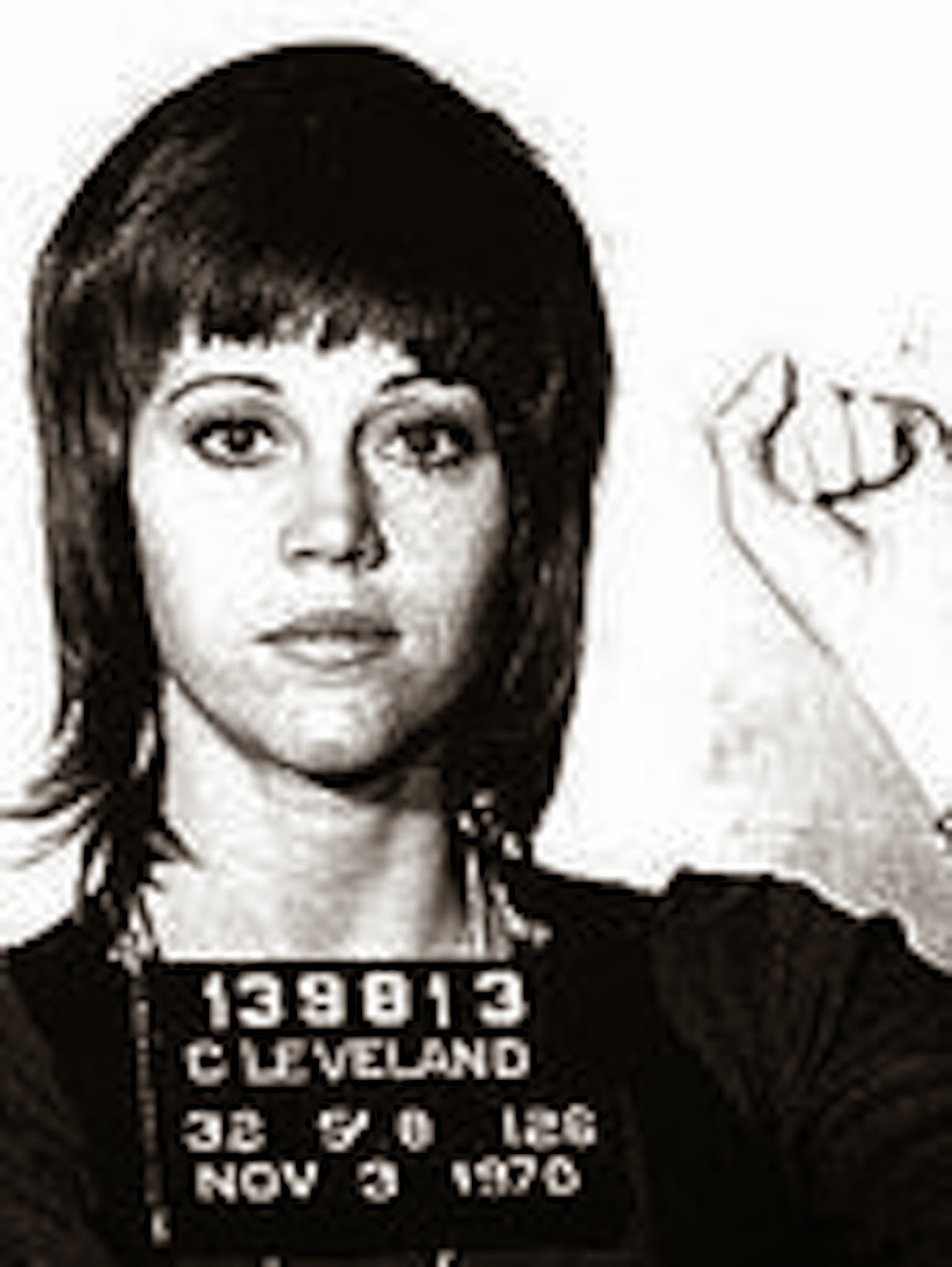
On November 3, 1970 Fonda began a tour of college campuses to raise funds for VVAW. (On that same date, Fonda was arrested for allegedly kicking a U.S. Customs agent; charges were later dropped. In the police mug shot, her raised left hand is clenched in a “Black Power” or “Power to the People” salute).
In 1971 Fonda was the chief financier of VVAW’s Winter Soldier Investigation (WSI), which took place in Detroit from January 31 through February 2 of that year. The largest war crimes tribunal held in the U.S. during the Vietnam War, WSI featured a host of VVAW members who related gruesome stories of atrocities they claimed to have participated in or witnessed in Vietnam; they insisted that rape, torture and murder were standard practices for the American military. In reality, WSI was a continuation of the anti-U.S. war crimes propaganda campaign which had begun in Europe with KGB-sponsored events that were organized before the first American ground troops ever arrived in Vietnam. Several of the WSI discussion panel moderators were radical leaders who had previously met with top North Vietnamese and Vietcong representatives in Hanoi and Paris. Also present were leftist psychiatrists, psychoanalysts and clinicians, who pressured the witnesses to help end the war by publicly confessing their “crimes.”
In July-August 1972 Fonda made her infamous trip to North Vietnam. By this time, over 50,000 Americans had been killed in the war. While there, she posed for pictures on an anti-aircraft gun that had been used to shoot down American planes, and she volunteered to do a radio broadcast from Hanoi. She made approximately eight radio addresses, during which she told American pilots in the area:
“Use of these bombs or condoning the use of these bombs makes one a war criminal … Examine the reasons given to justify the murder you are being paid to commit … I don’t know what your officers tell you ... but [your] weapons are illegal and that’s not just rhetoric ... The men who are ordering you to use these weapons are war criminals according to international law, and in the past, in Germany and Japan, men who committed these kinds of crimes were tried and executed.”
Fonda also quoted Ho Chi Minh during some of these broadcasts. She referred to President Richard Nixon as a “new-type Hitler,” and advised South Vietnamese soldiers to desert: “You are being used as cannon fodder for U.S. imperialism.”
These radio addresses were aired repeatedly by the North Vietnamese Communists, for whom propaganda was a key tool of psychological warfare; they used the broacasts not only to hearten their own citizens, but also to undermine the American public's will to go forward with the war, and to crush the morale of U.S. and allied forces.
In an effort to explain why she made her broadcasts over Radio Hanoi, Fonda writes in her autobiography that she had mainly wanted to educate U.S. pilots about the great harm their bombing campaigns were inflicting on innocent people. But in fact, most of what Fonda said was of a highly political nature. Many of the statements had been scripted for her by the North Vietnamese. Among her statements were the following (as catalogued by Henry Mark Holzer):
"I want to publicly accuse Nixon here of being a new-type Hitler whose crimes are being unveiled."
"The Vietnamese people will win."
"Nixon is continuing to risk your [American pilots'] lives and the lives of the American prisoners of war . . . in a last desperate gamble to keep his office come November. How does it feel to be used as pawns? You may be shot down, you may perhaps even be killed, but for what, and for whom?"
"[President Nixon] defiles our flag and all that it stands for in the eyes of the entire world."
"Knowing who was doing the lying, should you then allow these same people and some liars to define for you who your enemy is?"
"The only way to end the war is for the United States to withdraw all its troops, all its airplanes, its bombs, its generals, its CIA advisors and to stop the support of the . . . regime in Saigon . . . ."
"There is only one way to stop Richard Nixon from committing mass genocide in the Democratic Republic of Vietnam, and that is for a mass protest . . . to expose his crimes . . . ."
"In 1969-1970 the desertions in the American army tripled. The desertions of the U.S. soldiers almost equaled the desertions from the ARVN army . . . ."
"Perhaps the soldiers . . . who have suffered the most . . . [are] the black soldiers, the brown soldiers, and the red and Asian soldiers."
"Should we be fighting on the side of the people who are, who are murdering innocent people, should we be trying to defend a government in Saigon which is putting in jail tens of thousands of people into the tiger cages, beating them, torturing them . . . . And I don't think . . . that we should be risking our lives or fighting to defend that kind of government."
"We . . . have a common enemy—U. S. imperialism."
"We thank you [the Viet Cong and North Vietnamese] for your brave and heroic fight."
"Nixon's aggression against Vietnam is a racist aggression [and] the American war in Vietnam is a racist war, a white man's war."
"I heard horrifying stories about the treatment of women in the U.S. military. So many women said to me that one of the first things that happens to them when they enter the service is that they are taken to see the company psychiatrist and they are given a little lecture which is made very clear to them that they are there to service the men."
"The POWs appear to be healthy and fit. . . . All of them have called publicly for an end to the war and signed a powerful antiwar letter . . . ."
"A few of them [the POWs] tell me they, too, are against the war and want Nixon to be defeated in the upcoming elections. They express their fear that if he is reelected, the war will go on and on . . . and that bombs might land on their prison."
"I am asked to convey their [the POWs'] hopes that their families will vote for George McGovern."
"I ask them [POWs] if they feel they have been brainwashed or tortured, and they laugh."
"We read with interest about the growing numbers of you [South Vietnam Army troops] who are understanding the truth and joining with your fellow countrymen to fight for freedom and independence and democracy [i.e., with the Communists]. . . . We think that this is an example of the fact that the democratic, peace-loving, patriotic Vietnamese people want to embrace all Vietnamese people in forgiveness, open their arms to all people who are willing to fight against the foreign intruder.
In addition to the foregoing statements, Fonda also said:

that the Vietnamese people were peasants—leading a peaceful, bucolic life before the Americans came to destroy Vietnam.
that the Vietnamese were seeking only "freedom and independence" — which the United States wanted to prevent them from having.
that the million infantry troops which the United States put into Vietnam, and the Vietnamization program, had failed.
that Patrick Henry's slogan "liberty or death" was not very different from Ho Chi Minh's "Nothing is more valuable than independence and freedom."
that President Nixon had violated the 1954 Geneva Accords.
that the United States must get out of South Vietnam and "cease its support for the . . . Thieu regime."
that American troops were fighting for ESSO, Shell and Coca-Cola.
that the soldiers of the South Vietnamese army were "being sent to fight a war that is not in [their] interests but is in the interests of the small handful of people who have gotten rich and hope to get richer off this war and the turning of [their] country into a neocolony of the United States."
that American soldiers in Vietnam had discovered "that their officers were incompetent, usually drunk . . . ."
that she had recently talked to "a great many of these guys [black American soldiers] and they all expressed their recognition of the fact that this is a white man's war, a white businessman's war, that they don't feel it's their place to kill other people of color when at home they themselves are oppressed and prevented from determining their own lives."
Such statements could have had only one purpose: to provide aid and comfort to America's Communist enemy. Fonda's propaganda efforts played a major role in prolonging the war and increasing the death toll. As North Vietnamese Colonel Bui Tin explained in a postwar interview with The Wall Street Journal, the American antiwar movement "was essential to our strategy. Support for the war from our rear [China] was completely secure while the American rear was vulnerable. Every day our leadership would listen to world news over the radio at 9 a.m. to follow the growth of the American antiwar movement. Visits to Hanoi by people like Jane Fonda . . . gave us confidence that we should hold on in the face of battlefield reverses."
As Henry Mark Holzer details, Fonda, while in Hanoi, also spent time doing the following:
Touring such North Vietnamese sites as the so-called "War Crimes" museum, a hospital, a textile center, and numerous populated areas -- always in the company of North Vietnamese civilian and military officials as well as members of the international press -- and there making pro-Communist and anti-American propaganda statements.
Making pro-Communist, anti-American propaganda statements to a French journalist, to reporters at a press conference in Hanoi, and to North Vietnamese Vice Premier Nguyen Duy Trinh
Posing -- in the company of Communist civilian and military officials and members of the international press -- in the control seat of a North Vietnamese anti-aircraft gun, pretending to take aim on an imaginary American aircraft
As evidenced by some of the quotes above, Fonda visited American prisoners of war and reported (falsely) that they had not been tortured. Consider the account of Michael Benge, a civilian advisor captured by the NLF in 1968 and held as a POW for five years, who writes:
“When Jane Fonda was in Hanoi, I was asked by the camp communist political officer if I would be willing to meet with her. I said yes, for I would like to tell her about the real treatment we POWs were receiving, which was far different from the treatment purported by the North Vietnamese, and parroted by Jane Fonda, as ‘humane and lenient.’ Because of this, I spent three days on a rocky floor on my knees with outstretched arms with a piece of steel re-bar placed on my hands, and beaten with a bamboo cane every time my arms dipped.”
Former POW David Hoffman, whose plane was shot down over North Vietnam in 1971, also says that he was tortured because of Fonda’s visit to Hanoi:
“The torture resulted in a permanent injury that plagues me to this day,” explains Hoffman, whose arm is now disfigured because of the brutal treatment he received from communist guards at his POW camp. “When Jane Fonda turned up, she asked that some of us come out and talk with her. No one wanted to. The guards got very upset, because they sensed the propaganda value of a famous American war protestor proving how well they were treating us. A couple of guards came to my cell and ordered me out. I resisted, and they got violently angry. My arm had been broken when I was shot down, and the Vietnamese broke it a second time. It had not healed well, and they knew it caused me great pain. They twisted it. Excruciating pain ripped through my body. Still I resisted and they got more violent, hitting me and shouting, ‘You must go!’…I was dragged out to see Fonda. I decided to play the role. I knew if I didn’t, not only would I suffer -- but the other guys would be tortured or beaten or worse.”
When Fonda returned to the U.S., she told college students, “I bring greetings from our Vietnamese brothers and sisters,” and she lamented the war damage that she had seen in North Vietnam -- inflicted, she said, by U.S. forces. She also sported a necklace given to her by the North Vietnamese Communists, made from the melted parts of a U.S. aircraft they had shot down.
Whenever stories about POWs getting tortured emerged, Fonda called them lies. When the POWs began coming home in 1973 and their accounts of torture began to gain credence, Fonda called the returning soldiers “liars, hypocrites, and pawns.” "Tortured men do not march smartly off planes, salute the flag, and kiss their wives," she said. "They are liars. I also want to say that these men are not heroes."
Even when the U.S. pulled its troops almost entirely out of Vietnam in 1973, Fonda and her new husband Tom Hayden were not satisfied; together they formed the Indochina Peace Campaign (IPC), which continued to mobilize radicals across the United States after the 1973 Paris Peace Agreement, at a time when most antiwar organizations had either closed down or moved on to other causes. The IPC worked tirelessly to cut American aid to the governments in Saigon and Phnom Penh and help the North Vietnamese Communists and the Cambodian Khmer Rouge overthrow them.
Fonda and Hayden also returned to Hanoi and went on to the “liberated zones” of South Vietnam (areas the Communists had conquered) to shoot the documentary Introduction to the Enemy, a propaganda piece depicting the North Vietnamese as peaceful patriots who, despite years of war and bloodshed, did not hate Americans and planned to create an ideal new society based on justice and equality.
Fonda would never express regrets or utter a word of protest when more than two million Indochinese peasants were slaughtered after American aid was cut off and the communists took complete control of South Vietnam and Cambodia in 1975. In fact, she refused to join folk singer and fellow antiwar activist Joan Baez in her protest against North Vietnam’s incarceration of more than 100,000 South Vietnamese because, as she told the National Press Club on September 26, 1979, she was unable to prove the veracity of the charges against the new communist regime.
Fonda’s activism was not limited to protests against American military involvement in Southeast Asia. She was also immersed in radical chic causes like the American Indian movement and Black Power. When Alcatraz Island was taken over by 79 American Indians on November 20, 1969, Fonda visited the site to show her solidarity with their occupation.
Fonda was also a strong supporter of Huey Newton and the Black Panthers, calling the latter “our revolutionary vanguard.” “We must support them with love, money, propaganda and risk,” she said. Fonda claimed that Newton was the only man she would trust to lead America (a claim she would later recant as having been “naïve and utterly wrong”), and also campaigned for the incarcerated Angela Davis and other black “political prisoners.”
Fonda spoke frequently and proudly about her radicalism, saying in 1970: “Revolution is an act of love; we are the children of revolution, born to be rebels. It runs in our blood.” In 1972 she declared, “I am not a do-gooder. I am a revolutionary. A revolutionary woman.”
Two weeks after the opening of her 1979 movie The China Syndrome (which depicted an accident at a nuclear energy plant), there was a real nuclear accident at Three Mile Island causing small amounts of radioactivity to escape into the atmosphere. Fonda called this “the most shocking synchronicity between real life catastrophe and movie fiction ever to have occurred,” and took off with her husband on a 52-city anti-nuclear tour. Joining Fonda and Hayden on tour were leftwing stalwarts Bonnie Raitt and Jackson Brown.
Another pet cause of Fonda (and of her ex-husband Ted Turner) is population control. Fonda served as President Bill Clinton’s special “good-will” ambassador to the United Nations Population Fund, and gave a speech at the UN where she complained: “Our species alone co-opts, consumes or eliminates 40% of the Earth's … energy … We must fight to ensure universal access to family planning ... backed up with safe abortion.”

In 1999 Fonda was named one of the “100 Most Important Women in the 20th Century” by ABC News and Ladies Home Journal. It was later revealed that four of the seven women who had placed Fonda on the list had also worked to prevent President Clinton from being impeached.
Over the years, Fonda has given campaign contributions to such political figures as Hillary Clinton, Barbara Boxer, Tom Daschle, Max Cleland, Cynthia McKinney and Nancy Pelosi. She also gave $100,000 to the Al Gore recount effort in Florida in 2000 (following the election controversy), $5,000 to NARAL Pro-Choice America, and $4,000 to the MoveOn political action committee.
Fonda continues to participate in the antiwar/peace movement, particularly with regard to the Middle East and the War on Terror. She visited a Palestinian refugee camp and was scheduled to meet with Yasser Arafat, though the meeting never occurred. And just days after terrorists had killed some 3,000 people on 9/11, Fonda said that instead of retaliation, the U.S. should try to understand the “underlying reasons” behind the murderous attacks.
In 2003 Fonda made clear her opposition to the war in Iraq, stating: “What's it going to mean for [U.S.] stability as a nation, for terrorism, for the economy I can't imagine. I think the entire world is going to be united against us.” She was also critical of her fellow American citizens: “I don’t know if a country where the people are so ignorant of reality and of history, if you can [call] that a free world.” To express her opposition to the war, Fonda signed on to the “Not in Our Name” campaign, which was directed by C. Clark Kissinger, a longtime Maoist activist and member of the Revolutionary Communist Party.
In 2004 Fonda, in a joint effort with Vagina Monologues playwright Eve Ensler, initiated “Vaginas Vote,” a pro-John Kerry get-out-the-vote campaign that sponsored events in more than 30 states. A Fonda press release promoting a September 13th “Vaginas Vote” rally in New York stated, “Vaginas Vote, Chicks Rock. ... [O]rganizers are using the power of arts and activism to motivate and inspire all women -- especially young women -- to raise their voices and get out the vote to end violence against women and girls.”
The “Vagina's Vote” event was aimed at persuading young women to vote in favor of John Kerry in the 2004 Presidential election, the implication being that another Bush term would mean higher levels of violence against women than would a Kerry presidency. At the aforementioned New York rally, Ms. Ensler said to the attendees: “Are there are any registered vaginas in the house? . . . Step into your vaginas and get the vagina vote out.” Among those in the audience were Susan Sarandon, Gloria Steinem, Democratic Rep. Jan Schakowsky, and Jesse Jackson.
In April 2005 Fonda released her autobiography My Life So Far, in which she discussed, among many topics, her infamous trip to North Vietnam. In an interview to promote the book, Fonda described her visit with the Viet Cong as a “betrayal” of American forces and of the “country that gave me privilege.” She called it the “largest lapse of judgment that I can even imagine.” However, she said she did not regret having met with American POWs in North Vietnam or having made propaganda broadcasts on Radio Hanoi. “Our government was lying to us and men were dying because of it, and I felt I had to do anything that I could to expose the lies and help end the war,” she said.
In September 2005 Fonda made two appearances with British Member of Parliament George Galloway (who had been on Saddam Hussein's payroll and had illegally received about $585,000 in annual profits from Iraq's exports under the Oil-For-Food program) during his twelve-city speaking tour of the U.S., where he condemned America's war efforts in Iraq as both illegal and immoral. (Fonda was originally scheduled to make eight appearances with Galloway, but changed her plans so as to avoid drawing attention away from Cindy Sheehan's anti-war tour that was in progress at the time.)
In a 2011 biography of Jane Fonda, author Patricia Bosworth revealed a lifelong lament by the actress: “My biggest regret” Bosworth quotes Fonda as having said during a “feminist consciousness-raising session,” “is I never got to f*** Che Guevara.”
In 2012, Fonda acknowledged that she had used bad judgment in posing for the 1972 photos aboard the North Vietnamese anti-aircraft gun -- though she was careful to defend her decision to visit Hanoi: “I did not, have not, and will not say that going to North Vietnam was a mistake. I have apologized only for some of the things that I did there, but I am proud that I went.”
In July-August 1972 Fonda made her infamous trip to North Vietnam. By this time, over 50,000 Americans had been killed in the war. While there, she posed for pictures on an anti-aircraft gun that had been used to shoot down American planes, and she volunteered to do a radio broadcast from Hanoi. She made approximately eight radio addresses, during which she told American pilots in the area:
“Use of these bombs or condoning the use of these bombs makes one a war criminal … Examine the reasons given to justify the murder you are being paid to commit … I don’t know what your officers tell you … but [your] weapons are illegal and that’s not just rhetoric … The men who are ordering you to use these weapons are war criminals according to international law, and in the past, in Germany and Japan, men who committed these kinds of crimes were tried and executed.”
Fonda also quoted Ho Chi Minh during some of these broadcasts. She referred to President Richard Nixon as a “new-type Hitler,” and advised South Vietnamese soldiers to desert: “You are being used as cannon fodder for U.S. imperialism.”
These radio addresses were aired repeatedly by the North Vietnamese Communists, for whom propaganda was a key tool of psychological warfare; they used the broacasts not only to hearten their own citizens, but also to undermine the American public’s will to go forward with the war, and to crush the morale of U.S. and allied forces.
In an effort to explain why she made her broadcasts over Radio Hanoi, Fonda writes in her autobiography that she had mainly wanted to educate U.S. pilots about the great harm their bombing campaigns were inflicting on innocent people. But in fact, most of what Fonda said was of a highly political nature. Many of the statements had been scripted for her by the North Vietnamese. Among her statements were the following (as catalogued by Henry Mark Holzer):
“I want to publicly accuse Nixon here of being a new-type Hitler whose crimes are being unveiled.”
“The Vietnamese people will win.”
“Nixon is continuing to risk your [American pilots'] lives and the lives of the American prisoners of war . . . in a last desperate gamble to keep his office come November. How does it feel to be used as pawns? You may be shot down, you may perhaps even be killed, but for what, and for whom?”
“[President Nixon] defiles our flag and all that it stands for in the eyes of the entire world.”
“Knowing who was doing the lying, should you then allow these same people and some liars to define for you who your enemy is?”
“The only way to end the war is for the United States to withdraw all its troops, all its airplanes, its bombs, its generals, its CIA advisors and to stop the support of the . . . regime in Saigon . . . .”
“There is only one way to stop Richard Nixon from committing mass genocide in the Democratic Republic of Vietnam, and that is for a mass protest . . . to expose his crimes . . . .”
“In 1969-1970 the desertions in the American army tripled. The desertions of the U.S. soldiers almost equaled the desertions from the ARVN army . . . .”
“Perhaps the soldiers . . . who have suffered the most . . . [are] the black soldiers, the brown soldiers, and the red and Asian soldiers.”
“Should we be fighting on the side of the people who are, who are murdering innocent people, should we be trying to defend a government in Saigon which is putting in jail tens of thousands of people into the tiger cages, beating them, torturing them . . . . And I don’t think . . . that we should be risking our lives or fighting to defend that kind of government.”
“We . . . have a common enemy—U. S. imperialism.”
“We thank you [the Viet Cong and North Vietnamese] for your brave and heroic fight.”
“Nixon’s aggression against Vietnam is a racist aggression [and] the American war in Vietnam is a racist war, a white man’s war.”
“I heard horrifying stories about the treatment of women in the U.S. military. So many women said to me that one of the first things that happens to them when they enter the service is that they are taken to see the company psychiatrist and they are given a little lecture which is made very clear to them that they are there to service the men.”
“The POWs appear to be healthy and fit. . . . All of them have called publicly for an end to the war and signed a powerful antiwar letter . . . .”
“A few of them [the POWs] tell me they, too, are against the war and want Nixon to be defeated in the upcoming elections. They express their fear that if he is reelected, the war will go on and on . . . and that bombs might land on their prison.”
“I am asked to convey their [the POWs'] hopes that their families will vote for George McGovern.”
“I ask them [POWs] if they feel they have been brainwashed or tortured, and they laugh.”
“We read with interest about the growing numbers of you [South Vietnam Army troops] who are understanding the truth and joining with your fellow countrymen to fight for freedom and independence and democracy [i.e., with the Communists]. . . . We think that this is an example of the fact that the democratic, peace-loving, patriotic Vietnamese people want to embrace all Vietnamese people in forgiveness, open their arms to all people who are willing to fight against the foreign intruder.
In addition to the foregoing statements, Fonda also said:
that the Vietnamese people were peasants—leading a peaceful, bucolic life before the Americans came to destroy Vietnam.
that the Vietnamese were seeking only “freedom and independence” — which the United States wanted to prevent them from having.
that the million infantry troops which the United States put into Vietnam, and the Vietnamization program, had failed.
that Patrick Henry’s slogan “liberty or death” was not very different from Ho Chi Minh’s “Nothing is more valuable than independence and freedom.”
that President Nixon had violated the 1954 Geneva Accords.
that the United States must get out of South Vietnam and “cease its support for the . . . Thieu regime.”
that American troops were fighting for ESSO, Shell and Coca-Cola.
that the soldiers of the South Vietnamese army were “being sent to fight a war that is not in [their] interests but is in the interests of the small handful of people who have gotten rich and hope to get richer off this war and the turning of [their] country into a neocolony of the United States.”
that American soldiers in Vietnam had discovered “that their officers were incompetent, usually drunk . . . .”
that she had recently talked to “a great many of these guys [black American soldiers] and they all expressed their recognition of the fact that this is a white man’s war, a white businessman’s war, that they don’t feel it’s their place to kill other people of color when at home they themselves are oppressed and prevented from determining their own lives.”
Such statements could have had only one purpose: to provide aid and comfort to America’s Communist enemy. Fonda’s propaganda efforts played a major role in prolonging the war and increasing the death toll. As North Vietnamese Colonel Bui Tin explained in a postwar interview with The Wall Street Journal, the American antiwar movement “was essential to our strategy. Support for the war from our rear [China] was completely secure while the American rear was vulnerable. Every day our leadership would listen to world news over the radio at 9 a.m. to follow the growth of the American antiwar movement. Visits to Hanoi by people like Jane Fonda . . . gave us confidence that we should hold on in the face of battlefield reverses.”
… When Fonda returned to the U.S., she told college students, “I bring greetings from our Vietnamese brothers and sisters,” and she lamented the war damage that she had seen in North Vietnam — inflicted, she said, by U.S. forces. She also sported a necklace given to her by the North Vietnamese Communists, made from the melted parts of a U.S. aircraft they had shot down.
Whenever stories about POWs getting tortured emerged, Fonda called them lies. When the POWs began coming home in 1973 and their accounts of torture began to gain credence, Fonda called the returning soldiers “liars, hypocrites, and pawns.” “Tortured men do not march smartly off planes, salute the flag, and kiss their wives,” she said. “They are liars. I also want to say that these men are not heroes.”
… Fonda and Hayden also returned to Hanoi and went on to the “liberated zones” of South Vietnam (areas the Communists had conquered) to shoot the documentary Introduction to the Enemy, a propaganda piece depicting the North Vietnamese as peaceful patriots who, despite years of war and bloodshed, did not hate Americans and planned to create an ideal new society based on justice and equality.
If you follow the link above, you can also read about how her visit directly led to the torture of American POWs. Jim Hoft has pictures of her time at Hanoi, too.
She’s encouraging people to read what really happened? Well, that’s what we’re doing, and I see one thing. I see that Jane Fonda is a traitor, who without a doubt provided aid and comfort to our enemy during the Vietnam War, repeatedly. She provided propaganda for the North Vietnamese. She caused the torture of our POWs and the turned around and slandered them when they got back. If treason is defined by “providing aid and comfort to our enemies”, then Jane Fonda is surely a traitor. And that isn’t some “right-wing myth”. It’s a FACT.
THIS IS MY RESEARCH YOU DECIDE TRAITOR OR NOT!


